Business Tax Planning

Business Growth, Business Tax Planning

Small Business Tax Credit Updates San Francisco Bay Area Owners Will Want to Consider

We wanted you to know about something that came across our desks the other day because it is potentially very good news… Not many are talking about this, but there have been some MAJOR new Economic Injury Disaster Loan (EIDL) program updates from the SBA… While I like to steer clear from “recommending” that anyone take out a loan, San Francisco Bay Area businesses seeking low-cost access to capital absolutely should be evaluating the EIDL option in light of the new and highly favorable changes. These are 3.75%, fixed-rate, no fees (if you apply directly through SBA), 30-year repayment term, and no personal guarantee if the amount is $200,000 or less … … those are pretty incredible terms. Thought you’d be interested. (Though the response time on actually receiving increased funds has widely run the gamut, from what we’re hearing. Don’t expect that this will be a “rapid” infusion of cash.) That’s just one of a few changes you should know about. The rest, we’ll cover below… Small Business Tax Credit Updates San Francisco Bay Area Owners Will Want to Consider“I always tried to turn every disaster into an opportunity. ”  – John D. Rockefeller Businesses and their owners the country over have been enjoying some great small business tax credits from the federal government in the last 18 months. But, as 2021 is winding down, it’s important to know that some of them are on their way out. Small business tax credits soon ending for San Francisco Bay Area employers this year: So, let’s start by talking about the Employee Retention Credit (ERC), which has been a tax boon to small and midsize San Mateo businesses trying to keep people on the payroll. Washington looked to keep the ERC available through the end of the year, but the powers that be on Capitol Hill may pull the plug early as part of that headline infrastructure bill. Nobody knows right now if the ERC or some version of it will stay alive. Stay tuned. Small business tax credit changes in the pipeline – maybeNow we come to what might happen. Lawmakers love to change things, and there are proposals right now to do just that to your taxes … and, of course, not always in a good way. You have to plan for a lot of outcomes, sometimes. For instance, if your company is what’s called “a pass-through entity,” there’s a new bill in Washington you should know about. The Small Business Tax Fairness Act will try to lower the amount of money you can make and still get the tax deduction for your “qualified business income.” On the plus side, the Act does also look to expand who can take the deduction to include accountants, financial advisors, attorneys, doctors, and other professionals. Please get in touch if you’re one of these companies and want to know more. Never a dull momentRecent events have inspired some to think, “I’ve had it. I’m selling my San Francisco Bay Area business and retiring sooner rather than later.” If you’re in this camp, as far as taxes go, you have two choices: Slam on the brakes or put the pedal to the metal. Crazy, right? But this schizophrenia can be explained because “tax the rich” proposals in Washington want to hike capital gains taxes and kill the step-up in basis (a type of valuation for tax purposes that historically has protected heirs from larger tax bills). So, you’re stuck. Sell your business down the road, and you could be socked with a big capital gains tax bill. Leave the business to your heirs instead, and the IRS may wallop them eventually because by that time they’ll no longer have the shield of step-up in basis. What to do about these small business tax credits from the federal government coming to an end? Well, the discussion about the above on Capitol Hill is still, right now, just proposals. That could change any day. Watch for more back and forth in Washington. And, for the rest of us in the real world, more suspense as we plan for taxes. If you sell online, watch outLet’s look at state taxes, too – especially if your San Jose business has joined the e-commerce boom, and you sell over the internet. You may have noticed that states (and other tax jurisdictions – watch out here for cities and even towns) are always claiming to be short of cash. With not as many people staying in hotels or eating in restaurants over the past several months, that’s a lot of sales tax states didn’t collect. So, what are they doing about it? Looking around for small businesses that sell more products online. This actually started a few years ago with a Supreme Court case called Wayfair. It basically gave the green light to states to start demanding that if you sold enough in their area, you have to collect and send back to states sales tax on the purchases no matter where your business is. Sounds simple – except every state and more than a few municipalities around the county have their own tax rates and deadlines for you to file and pay. And they’ve plenty of penalties to whip out if you mess up. Typically, you do have to sell about six figures annually in the state or have a set number of transactions – but these rules change all the time. In this and all tax matters, your business is too valuable to leave to chance. Talk to us if you need help with this ever-changing world. We’re always here to help you with this stuff … and ALL of your business. Patti (408) 241-4100  Gale 408-775-7800 To your bottom line… and to paying less tax, Patti ONeill and Gale Bergado(408) 241-4100ONeill & Bergado
Business Growth, Business Tax Planning

Is The Employee Retention Tax Credit Right For Your San Francisco Bay Area Business?

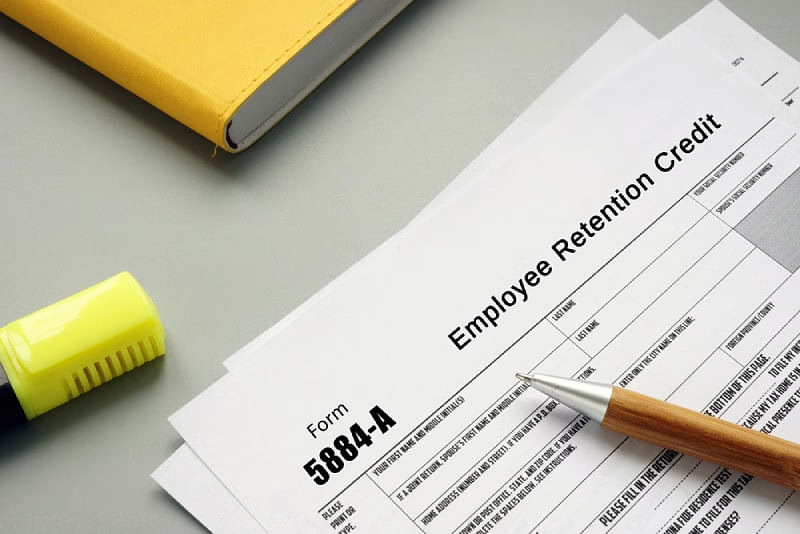
There is a LOT of smoke emanating from Congress right now. As usual, with Congress, there are always rumors and mutterings — what matters is what is actually signed into law. And we’ll keep you up to date on what you might need to know. But speaking of Congressional acts that have been signed into law … Wouldn’t it be great to get money for just having kept your San Francisco Bay Area employees afloat during the last rough-as-nails year or so? Well guess what? Maybe you can. Trouble is, Congress may soon take this deal away. Or it may not. Here’s the latest word on that and how you can still cash in – for now. Is The Employee Retention Tax Credit Right For Your San Francisco Bay Area Business?“Somewhere, something incredible is waiting to be known.” – Carl Sagan Late last year the Taxpayer Certainty and Disaster Tax Relief Act of 2020, following up on earlier relief laws, allowed the good folks at the IRS to give San Francisco Bay Area employers like you a real tax break. The Employee Retention Tax Credit (ERC) is a refundable tax credit – sort of a thank you from Uncle Sam – on the employer share of Social Security taxes that your business pays if you’ve been hit by the pandemic but kept your employees on payroll instead of laying them off.  Here’s how it works: If your San Francisco Bay Area business qualified, you could whack a chunk off what you paid in tax equal to, for this year, 70% of most wages you paid to employees through June 30. This applies to wages and compensation, in general, that are subject to Federal Insurance Contributions Act (FICA) taxes. How do you qualify? Two ways, primarily: You got dinged in the down economy or the government “closed you down” during a particular quarter because of the pandemic. Under the newest rules, if your business took at least a 20% hit for a quarter in 2021 compared to the same quarter in 2019, you are eligible. ERC regs for 2020 required a 50% decline over the same quarter in 2019 (or a government shutdown). A company can now have up to 500 full-time employees and qualify, up from 100 under old ERC regs. (Bigger companies can also qualify, but the wage restrictions are a little tighter.) The newer rules added ERC eligibility for the second half of this year for more businesses like public universities, hospitals and medical-care providers, “recovery startup businesses” that opened their doors after Feb. 15, 2020, and for all wages including for work and for paid time off. You can only get seven grand per employee per quarter max in 2021 but still, who couldn’t use this kind of cash? Where do you sign up? Not so fast – enter Congress Even as we speak, the House of Representatives is batting around the Bipartisan Infrastructure Investment and Jobs Act. It passed the Senate recently and the House is tweaking its own version. What’s that got to do with your tax break for keeping people on the job? A lot, as it turns out. Capitol Hill is thinking of killing the ERC for the last quarter of this year. Even if they don’t, they might tweak it so your San Francisco Bay Area business can’t qualify. Stay tuned – this could change or all be settled any hour. We’ll keep you up to date. Back to the future When the future’s uncertain, reach for the past: You can basically go back in time to apply for the Employee Retention Tax Credit . For instance, one of the beefs with the ERC in 2020 was that you couldn’t claim the credit if you’d received a Paycheck Protection Plan loan. Late last year, though,  the federal Consolidated Appropriations Act changed all that: Suddenly you could retroactively claim the ERC for payroll periods that were not paid with PPP loan money. No double-dipping, as it were. What’s it matter if Congress kills the ERC for the rest of this year? That’s when “retroactively” becomes a big word – you can amend past returns. To review: To qualify for the ERC, you had to have gross receipts fall significantly in a quarter of 2020 or 2021 compared with the same quarter in 2019, have operations unusually impacted by government order from the health emergency or you began business operations after mid-February 2020. Fit any of those? Then no matter what the House does in the coming days/hours/minutes, we can help you retroactively file using IRS Form 941-X (sounds like a spaceship but let us worry about that…) and possibly cash in with an ERC.   Yeah, you have to keep a lot straight to claim this tax credit – it would be no wonder if you’re confused. But if you think you fit those circumstances in any way, if you want to review your 2020 or 2021 quarterly payroll tax returns, or you know another business owner who could benefit, let’s chat. (408) 241-4100  To your bottom line… and to using the tax code to your advantage, Patti ONeill and Gale Bergado(408) 241-4100ONeill & Bergado

Business Tax Planning, IRS Audits

Using an IRS Accountable Plan to Maximize Deductions for Your San Francisco Bay Area Business

Any of you San Francisco Bay Area business owners remember those halcyon days when you could “talk a little business” with somebody while traveling … and then you got to write off the whole getaway on your taxes? Even if that ever really happened, that ain’t today. Now, the good folks at the IRS pull against their leashes to get at businesspeople who try to finagle an on-the-job tax deduction – and the taxman’s very best friend can be your own sloppy records. Get yourself an “IRS accountable plan.”  (Ahem.)Patti (408) 241-4100 Gale 408-775-7800 And before I dive into all that, one more reminder that this Friday, October 15th is the deadline for extended federal personal tax returns for 2020 (for the vast majority of the country). If you need a quick chat on this, use the info above and get in touch. In the meantime, let’s get your books “on lock” as the young people say. (Do they still say that?) Using an IRS Accountable Plan to Maximize Deductions for Your San Francisco Bay Area Business“It is time to restore the American precept that each individual is accountable for his actions.” – Ronald Reagan “IRS accountable plan” is a fancy way of saying “Reimbursing your employees — and yourself — without making the taxman mad.” You and your employees often reach into your own pockets for legit business expenses – sometimes for just a couple of bucks but sometimes for a lot more. Used to be if you had enough of these expenses, you could deduct them on your personal tax return. Then came the Tax Cuts and Jobs Act of 2017. Maybe you heard about it? Well, it pretty much erased the regular taxpayer’s itemized deductions for business. But what happens if you still need copy paper or to drive your car to see a client (or for that matter, call a client on your personal cell phone)? Do you just have to eat that cost? IRS accountable plans are formal guidelines that you create, which explain how you reimburse your employees for expenses and which ones qualify for reimbursement. (Reimbursements for expenses aren’t wages, so they’re not subject to tax.) Sound good? Can be – but it takes work. The deduction is in the details You won’t have to submit your accountable plan to the IRS but, if you want your deductions to hold up to scrutiny (yes, that scary word: “audit”), it’s a good idea to know what your accountant plan should include. (By the way, we’re going to talk more here about the plan itself than about the deductions themselves.) First, your “IRS accountable plan” doesn’t have to be written – but why shouldn’t it be? It makes everything clear to everybody in your company – and the IRS respects paper. Your plan should cover how much time your employees have to submit expenses; how they ask for reimbursement, including what documents are needed; what you’ll reimburse them for; the max that you’ll reimburse; and when employees should give back leftover reimbursement money. The IRS likes it if your plan also makes crystal clear how the expenses relate to your business. They also have to be substantiated in what’s called “a reasonable period” and your employee has to give back any expenses money they don’t spend in, again, “a reasonable period.” The IRS does seem to think that 30, 60 or 120 days is “reasonable” depending on whether it’s for your employee submitting expenses, you paying them, or your employees paying back excess. Some San Mateo biz owners might wonder, “What about small stuff like tips? I need records for that?” Well, the IRS is a little cagey on what they think “small” is. Some biz owners probably think records for anything more than ten bucks is a good idea. Others probably say five. Don’t guess. Keep everything, take no chances, and just document, baby, document. Go for the record Sure, they’re a pain to keep, but detailed records strengthen your case. There’s just no way around that. Keep them with your IRS accountable plan. Get yourself a designated logbook (hey, that’s an expense, too) and keep receipts, bills, and credit card statements. Photocopies will work. Detail detail detail those expenses: amount, time, place, and reason for the spending. “Twenty bucks for gas” doesn’t fly like “Twenty bucks for gas for this employee, on this day and time, at this gas station, because my employee was headed here to meet this person and here’s exactly how the whole relates to my business.” More pointers: Check with us if you have any questions … and keep every scrap of paper for records (and keep it organized if you can). You’ll be glad you did. If you need help formulating this …  well, that’s what we’re here for.Patti (408) 241-4100  Gale 408-775-7800 To more of your business’s money trickling into the bottom line, Patti ONeill and Gale Bergado(408) 241-4100ONeill & Bergado

Business Growth, Business Tax Planning

San Francisco Bay Area Business Owners: Beware the Sales Tax Nexus

If your San Francisco Bay Area business sells a lot online, then we’re coming into the most wonderful time of the year. And this year, your customers will probably shop your website (and elsewhere online) EARLY in order to bypass all those supply-chain snafus. Cha-ching for you. Just don’t forget the taxman – and we don’t mean the IRS. We mean the sales tax in states where you sell your stuff. Yes, if you sell enough online, you’ve got to pay attention to the sales tax nexus. You see, you’d be amazed at how many times this topic becomes “a thing.” In fact, getting this wrong is one of the primary ways that businesses get in trouble with various revenue agencies (IRS and state revenue offices) because they don’t handle it properly. But before we dive into this, let’s make sure that your business (and your family) is also capturing every available income tax-saving strategy available right now, and do a little taxplanning: Find us here: Patti (408) 241-4100 Gale 408-775-7800 Now let’s get a little scary together, shall we? San Francisco Bay Area Business Owners: Beware the Sales Tax Nexus “The Internet, once heralded as an exciting new medium of communication, is now little more than a vast mail-order catalogue.” -Tom Hodgkinson Everybody who lives in a state with a sales tax knows about that extra little bit that gets tacked on to purchases. That’s usually the point in the retail cycle when you hear muttering about the mayor, the governor, and/or everybody in the state capital. That little bit is the local sales tax. Most states have one. What about when you buy something online? Just before you hit “check out,” that little amount gets tacked on there, too. What about when you’re the one selling over the internet? Have you ever heard of Wayfair? The home-goods and furniture company that does almost eight figures a year in global online sales? That Wayfair? How about the U.S. Supreme Court’s 2018 Wayfair decision? No? Well, that’s when our high court agreed with the state of South Dakota, which had long claimed that Wayfair owed sales tax from tons of transactions in that state. The Supreme Court then basically gave South Dakota the authority to tell all online sellers that if they sold more than the low six figures or a couple hundred sales a year in the state, then they had to collect and send back South Dakota sales tax. That’s because a company then had economic nexus. “Economic nexus?” Sounds serious. Is there a cure? Sure. If you sell enough, collect sales tax from your online customers and send it back to the state. Period. Taxing in a boom Now, most states enforce economic sales tax nexus – not to mention all the cities and even towns out there that levy their own sales tax based on economic nexus. (Not-so-fun fact: An office or a warehouse is one thing that can give a company “physical nexus.” So can your staff working remotely in another state – check with us ASAP on this…) States’ timing is suspiciously perfect: E-commerce and buying over the web were already red hot before the pandemic made it explode. Research shows that more than nine out of ten internet users worldwide have purchased products online and that e-commerce is growing annually at about a 23% clip. Holiday click-and-buy in the U.S. alone this year is expected to be in the hundreds of billions of dollars. That’s a lot of sales tax. In this case, your customers pay the tax. You collect and keep it for a set time – say a calendar quarter; depends on how often a tax jurisdiction makes you file – and then you send it into a department of taxation/revenue. Your next steps with the sales tax nexus Funny thing about people in the government who slap you with a tax: They tend to want to see the money. And they can get nasty when they don’t see it. Think “sales tax audit,” “fines,” or worse. If your San Francisco Bay Area business sells a lot into a state, check with that state’s department of taxation and see what the deal is under “sales tax economic nexus.” If you are over or near the thresholds of dollars or number of sales, keep the following in mind: – Taxability of your products. Not all jurisdictions levy sales tax on everything sold all the time. A lot of states have sales tax holidays for occasions like back-to-school shopping, for instance. Jurisdictions sometimes split hairs on tax exemption. Some states exempt groceries from sales tax, for example, but require you to charge a sales tax on other kinds of food. It can even depend on whether chocolate or other candy is involved, and what a state considers “candy,” and so on and so on… aren’t taxes fun? Again, check with the state. – Register. If you think you’ve got nexus in a state, register there to collect and remit sales tax. You can usually register online, which is fast. Most states let you register for free, but not all. – Keep track. You have to calculate the right tax to collect and send back; there’s software that can help with this. You also need to keep a calendar of when you’re supposed to file your sales tax return with what state and to keep up on all the notices. The taxman loves to send notices – and some might need your quick attention. You can handle this new tax obligation with a little work and attention – but don’t let it slide. If we can help, please let us know. Patti (408) 241-4100    Gale 408-775-7790 To your San Francisco Bay Area business staying out of hot water … Patti ONeill and Gale Bergado (408) 241-4100 ONeill & Bergado

Business Growth, Business Tax Planning

The Infrastructure Act and Your San Francisco Bay Area Business

Blink, and we’re already into December. Which also means… 2022 is right around the corner. Are you ready? The reason I put this so starkly is that you and I have less than 30 days left to make a tangible difference on your taxes (business or personal). For your business (whether it’s a pass-through entity like an LLC or a C-corp, etc.) we have to ensure that your P/L’s are accurate and that you are being wise about expenses that you should either put off or accelerate, and more. If you want to talk all of this through and get ahead of the game while you can, we’re right here: Patti (408) 241-4100  Gale 408-775-7800 But today I want to address the recently-signed infrastructure bill — this is a different bill than the one grabbing headlines now (the “Build Back Better” Act). The key difference for the infrastructure bill is … well, it is actually signed into law. Let’s look at how it might affect your business. The Infrastructure Act and Your San Francisco Bay Area Business“Americans: Time to gather up those receipts, get out those tax forms, sharpen up that pencil, and stab yourself in the aorta.” – Dave Barry On November 15, 2021, President Biden signed the Infrastructure Investment and Jobs Act into law. You’ve probably heard of it as the trillion-dollar-plus infrastructure bill. It has a lot to do with bridges, roads, drinking water, climate improvement, public transit, and internet broadband. It’s being called a “once-in-a-generation” law, and, yes, it is big news. A few of the new law’s tax provisions are high-flying: extending some highway taxes, tinkering with taxes for superfund sites, and allowing bonds for some broadband projects and climate-friendly facilities. There’s also a provision to extend relaxed funding requirements for employer-sponsored retirement plans. (We can tell you more about that one.) But the Act also tweaks taxes you and your San Francisco Bay Area business might pay. Let’s take a look at some of the biggest changes. Credit discard The Infrastructure Act will have a big impact on small businesses that planned to take advantage of a popular pandemic-related tax break. The Employee Retention Credit (ERC) was a real goody, a tax credit for a big chunk of the wages paid by companies that the pandemic clobbered on the bottom line. Now, this break is ending early. Maybe too early. The ERC wasn’t supposed to say goodbye until Dec. 31st but got an early sendoff on Sept 30th for most employers, courtesy of the Infrastructure Act. Any wages paid after that are now ineligible for the credit. Some recovery startups can still get the credit, but these companies had to have opened their doors after Feb. 15, 2020, and their gross receipts capped at six figures, among other conditions. (Business owners might also have a shot at retroactively claiming the ERC for prior quarters. Check with us to find out if you are.) Wait a minute – September 30th? That’s right, notice that Washington was too busy bickering to pass this bill before the end of the third quarter of this year, as was once planned. That could be a problem for businesses that used the ERC through October; those businesses might be asking if they’re going to be in trouble for not having sent in the payroll taxes for wages they thought they were getting a break on … You’re not alone in asking this. A lot of people are asking the same question. And it’s a good argument for why Washington should pass a bill when they say they’re going to. Regardless, we’ll keep you posted. Virtual reality If your San Francisco Bay Area business deals with cryptocurrency at all, the infrastructure bill has a tax whammy that’s anything but two-bit: All crypto transactions of five figures and up must now be reported to our “friends” at the IRS. This new ruling takes effect in 2023, so you’ll have to file your first “information reports” on these transactions by Feb. 15, 2024. For now, the focus is just on cryptocurrencies, but the taxman is keeping options open regarding what’s called “other assets” in the exploding digital marketplace. The phrase they’re using is “cryptoasset.” Sounds like a band your kids listen to. But be prepared for the broad-sweeping implications of that term… Don’t worry, we’ll keep you posted as changes roll in, so stay tuned. Disaster planning Currently, the IRS will often give taxpayersincluding businesses extra weeks (even months) to file returns/pay taxes if they’re in areas hard hit by various natural disasters — hurricanes, big blizzards, tornados, floods. But that extra time isn’t necessarily a gimme – the IRS doesn’t have to grant it. Now, the Infrastructure Act says if you’re in an area that’s been hit with a federally declared disaster, you get more time automatically. And “disasters” now also include major fires. The new law automatically gives a couple months’ relief after a disaster is declared. It covers filing and paying income, estate, gift, employment, or excise taxes, as well as filing a petition or notice of appeal with the Tax Court, among other extensions. If this sounds like no big deal for you, just remember: Nobody expects a disaster. This could come in handy. You never know. The only constant is change Washington’s never done with taxes. Other changes most likely loom in future headline bills like the Build Back Better package, and those are more likely going to be stuff that you’re used to seeing in biz taxes, like adjustments (see “increases”) to corporate rates and the cap on the tax deduction for state and local taxes. Or maybe not. If the Infrastructure Act taught us anything, it’s that you can’t be sure about new tax laws until the ink’s dry on the president’s signature. We’ll always keep you posted, and we’ll always be there to answer your questions. We’ll keep you in the know about tax law changes and how they affect your San Francisco Bay Area business. We’ll be here to answer

Business Tax Planning

How Your San Francisco Bay Area Business Can Fight Inflation

Whether you like it or not, you’ve most likely found yourself in a fight against inflation. Somebody hikes prices on your supplier and suddenly your supplier has no choice but to increase the price on you. Then you have no choice but to raise the price on your customer – who (even if they don’t tell you) notices … you can depend on that. Inflation is like that dung they say always rolls downhill — except the prices you pay go in the other direction. You don’t like charging your valued San Francisco Bay Area customers more… but what other choice do you have? Maybe you can’t break this cycle yourself, but you can soften the blow. And I have ideas for you today. But before I get there, let’s make SURE that your books are in order and that you are making wise year-end choices — i.e. accelerating or decelerating revenue and costs (dependent upon your tax situation) and more. If you want to get ahead of that stuff before it’s too late, find us here: (408) 241-4100 And once you’ve done so, come right back here so we can talk about pushing against the inflationary tidal wave. How Your San Francisco Bay Area Business Can Fight Inflation“It’s not what you pay a man but what he costs you that counts.” – Will Rogers As you know if you’ve had to shell out for nearly anything lately, inflation is on the rise. Of course, broadly speaking, inflation is simply costs going up. And this can be driven by a number of dynamics, but one of the most common is supply and demand. Well, we still have enough demand to go around — but in many areas, not enough supply… And so we have inflation occurring – more than 6% year over year. The U.S. Bureau of Labor Statistics says that inflation accelerated last March through September worse than any time in 2020. And it’s the worst year-over-year inflation rate in 30 years. Let’s hope inflation doesn’t go much higher. We can hope, can’t we? Still, there’s no way this doesn’t sting small businesses like yours. According to a recent survey, more than four out of five small businesses have had to increase prices  – and a good chunk of their customer base is complaining even as profit margins shrink for almost half the companies responding. Not good at all – and not getting better any time soon, at least as far as anybody can predict. So what can you do? Your best (and quickest) moves One common-sense response to inflation: Save money where you can. Fight Inflation Move #1 – Reduce inventory: What you sell is more than the lifeblood of your San Francisco Bay Area business – it’s probably also one of your biggest expenses. Yet think about it. Chances are good that a lot of your revenue comes from a relatively few number of items in your inventory. Try classifying your inventory into three groups based on their value to your business. The “A” group includes your biggest moneymakers, the “B” group is somewhere in the middle, and “C” items make you the least. Once you’ve figured this out, closely watch the supply chain, especially on your A items. If your suppliers are getting prone to longer or fluctuating lead times, stock up on their items when you can. And if you’re finding a lot of items in your “C” group, maybe consider ditching a few of them. Fight Inflation Move #2 – Improve your expense tracking: This not only helps you see where your money goes, but it also keeps you out of trouble with the IRS and makes sure you take every tax deduction you’ve got coming. Check with us if you’d like specific opinions on expense-tracking software, but generally, the price of this software will depend on the size of your company. Whatever you pick, scanning receipts is bound to be better than rooting through your shoebox – and it’ll make a big difference in your annual costs. Fight Inflation Move #3 – Fine-tune your marketing: It’s probably the worst move in the business book to give up trying to acquire new customers when times get tough – thinking like that just makes a tailspin spin out faster. Still, I bet your marketing has a lot of parts that could do with some tinkering. Too often in small businesses, marketing is launch-and-forget. Make the time to take a hard look at your advertisements, for example. Which ones pull in the customers? Which ones don’t? Work on (or just drop) the clunkers. After all, you’re paying good money for those. And remember: Keeping customers you already have is always cheaper than advertising to bring in new ones. Customer loyalty also becomes even more important during inflation. Fight Inflation Move #4 – Move to a cheaper workspace: The past couple of years have been a gut reno for the work world. For a lot of workers, the office is now their dining room table. Will this continue? Who knows … but do you really need to keep shelling out for all those square feet of office space? Don’t forget the price tag of furniture, utilities, and those mountains of Keurig cups. Cheaper alternatives can include co-working spaces, either for-hire or through a partnership with another local San Francisco Bay Area business. Ask around. Inflation sure isn’t fun, but it won’t last forever (it never has). We’re in this with you and your business, and if we can help at all, please reach out. Stay safe. (408) 241-4100 To a happy and prosperous year-end… Patti ONeill and Gale Bergado(408) 241-4100ONeill & Bergado

Business Tax Planning

Year-End Business Tax Strategy for San Francisco Bay Area SMB Owners

There are many of our clients for whom this time of year is like their version of the Super Bowl. Some San Francisco Bay Area businesses are earning 30-50% (or more) of their yearly revenue in this one month. Others … well, this is a normal month — except of course for all of the holiday craziness. But for ALL of our clients, this is a time where you can bring home some serious bacon. And one way you can do so is by making some tax moves before the clock strikes 12 on New Year’s Eve. Now I get it … the rush of customers and clients, strange hours, extra errands: It’s a tough time of year to think about tax. But the calendar waits for no business, and time is getting short to plan your moves. If you want to talk all of this through and get ahead of the game while you can, we’re right here: (408) 241-4100 In the meantime, let’s dive in. Year-End Business Tax Strategy for San Francisco Bay Area SMB Owners“We contend that for a nation to try to tax itself into prosperity is like a man standing in a bucket and trying to lift himself up by the handle.” – Winston Churchill Get your tax documents together to back the tax moves we talk about here and any others you might take. Consider temporary bookkeeping help through the end of this year and the beginning of 2022. Year End Business Tax Strategy #1: You’re the boss. If you have employees, you have some special tax preparations to think about concerning tax preparation this year. For one, if you have employees who worked remotely, you should find out ASAP if new laws in the states where these employees worked will create reporting and payment requirements for employment taxes. The end of the year is also a great time to make sure you’re getting the biggest tax bang out of your company’s retirement plan, anything from a SEP IRA to a Solo 401(k) to the combination of a 401(k) with a defined-benefit pension plan. Believe it or not, you have until the extended due date of your 2021 federal return to establish a qualified retirement plan and fund the plan for this year. And oh yeah: If you took advantage earlier this year of deferring payment of your portion of Social Security payroll tax liabilities that would have been due from March 27 through Dec. 31, get ready to pay half that deferred amount by the last day of 2021. Year End Business Tax Strategy #2: Timing’s everything. While we’re on the subject, wringing the most out of the business tax system often comes down to two things: deferment or acceleration. If you think you’re going to be in a higher tax bracket next year, do all your billings soon and collect on as many as you can before the end of 2021. You want that money sooner so you can be taxed on it in 2021. A much higher rate on long-term capital gains is also making its way steadily through the catacombs of Washington lawmaking – and since gain on the sale of a business or investment property is generally taxed at this rate, closing such a sale before year’s end might be the safest call. Year End Business Tax Strategy #3: You bet your assets. There’s no sign that this goody is going to change, but you should know that 100% first-year bonus depreciation is available for qualified new and used property acquired and placed in service in calendar 2021. You might be able to write off the entire cost of assets that you add this year. Regarding vehicles, passenger cars that your company puts into service in 2021 have limited deductibility, but SUVs, pickups, and vans don’t. What a deal. Or is it? This brings us to a key concept of tax planning. Examine tax breaks for whether they’ll continue: Will they be around next year? Will your tax rate be higher in 2022? You may want to wait and get the break then to lower your 2022 taxable income. Year End Business Tax Strategy #4: It’s your loss. The pandemic might have made this … well, let’s call it a “robust” area of activity for some businesses in recent years. Hope you weren’t one of them, but if you did get dinged on a few deals there are definitely some ducks you want to get in a row regarding losses. Did you have bad debts in 2021? You can get a write-off if that debt is wholly uncollectible by the end of the year. Damaged or abandoned property can generate ordinary losses for specific assets; so can some insolvent subsidiaries. Also, make sure that your business has filed claims for all net operating loss (NOL) carrybacks. You still have until Dec. 31 to file for NOLs originating in 2020. Year End Business Tax Strategy #5: Credit due. The taxman isn’t completely without heart, and the feds, along with a lot of states and local governments, offer a lot of tax credits for things like research and development, innovation and technology, renewable energy, and investing in low-income communities. Stroll back through your 2021 memory lane to make sure you’re claiming all the tax credits you might have coming – and, just as important, begin eyeing possible tax credits for your activities planned for 2022. This is just a sample of business tax strategy to help you save before the end of the year. We can also discuss if your San Francisco Bay Area company is the right kind of business entity for the best tax leverage or how our good state’s taxes might influence your moves between now and New Year’s. Give us a buzz. We’d be happy to talk more about the details – and about you. Happiest of holidays. (408) 241-4100 To more holiday bacon staying in your pocket, Patti ONeill and Gale Bergado(408) 241-4100ONeill & Bergado

Business Growth, Business Tax Planning

4 Year End Tax Strategies for San Francisco Bay Area Businesses

Before I dive into some year end tax strategies San Francisco Bay Areabusiness owners can and should be making, I want to address some rumors and misinformation about the SALT workarounds that are available to some of our clients (though not all). Essentially, 22 states (as of this writing) have enacted legislation that enables business owners operating in a partnership or S-corp to deduct their state and local taxes (SALT) beyond the 10K cap that exists on federal returns. These are the states that currently provide this workaround in some measure: (source article here) Contrary to what some tax practitioners have been saying, in most cases, you do NOT need to pay these taxes by 12/31/21 to elect for this workaround (if you are eligible). In almost every case, you make this election when you file your entity tax return (often on March 15th), and it will then enable you to claim that deduction on your personal return. There are nuances state by state (for instance, the deadline to have made this election in New York has already passed). But do NOT fall prey to the rumors that you have to suddenly write a big check right now, this week, to have this help you. If you need to talk this over, we’re right here:(408) 241-4100 (And please be patient. I can’t guarantee our availability, as we have a LOT of client work to handle these few days before year-end … but we’ll do our best!) Now … a few year end tax strategies you might should consider this last week of the year, in case you haven’t already… 4 Year End Tax Strategies for San Francisco Bay Area Businesses“We didn’t lose the game; we just ran out of time.”  -Vince Lombardi As I mentioned to my family clients, time is short, and some moves do require more than this week to pull off — so I’m restricting myself to year end tax strategies which you can realistically do something with before the end of the year. And, again–these are focused on what will apply to your San Francisco Bay Area business. If you didn’t get that list for a personal/family return, let me know, and we’ll shoot it over to you. 1) Buy Supplies in Advance (to increase expenses and offset income)How much disposable equipment do you expect to use in 2022? Order it now so the cost is deductible in 2021 if you need to offset income. Buy what you think you’ll need for the coming year, as long as you have the space to store it. This is especially easy to do with software, information courses, or other subscriptions that you know you want to keep. A word of caution: Under a 12-month rule, you cannot deduct prepaid expenses that run more than the end of the year following the current year. For example, if you prepay a three-year subscription to a trade journal, the cost is deductible over three years (not just one). 2) Work Now, Bill LaterInstead of sending an invoice immediately so you’ll receive payment this week, consider waiting until next week. This will ensure that payment is received in 2022, and taxes on the income are deferred for another year. However, it may make sense to adopt the opposite approach — bill immediately to receive the income this year. 3) Get Ahead On Other Vendor CostsYou may have bills piled up that are not due until 2022. If you pay them now, you can deduct the expenses in 2021. Don’t have the funds in your bank account at the moment? Consider putting the expenses on your business credit card if the vendor or other party allows it. Costs charged to credit cards before the end of the year are deductible this year even though the credit card bill isn’t due until 2022. 4) Pay Out Some Year-End BonusesMany companies do NOT do this, but this is a quick way that you can reduce your taxable income for 2021 in your San Francisco Bay Area business. Obviously, you’ll need to move rather fast on this and do it through your payroll system. I know there aren’t many hours left to make these year end tax strategies, but if you can squeeze out just a little time for them, you’ll see the good they’ll bear on this year’s taxes. Let’s make the most of what’s left of 2021 and finish strong. Happy New Year, Patti ONeill and Gale Bergado(408) 241-4100ONeill & Bergado

Business Growth, Business Tax Planning

Getting Started with Metrics and KPIs in Your San Francisco Bay Area Business

Your car dashboard tells you how far you’ve driven and how much gas is left in the tank. Your smartphone has a button to tell you how much space you’ve got left after taking all those pictures of the kids. Your bank’s all too happy to show you a report on how your accounts are doing. You need the same kind of statistical insights for your San Francisco Bay Area small business. They’re called “Key Performance Indicators” or KPIs. Metrics and KPIs use information you’ve measured and verified to tell you how you’re progressing toward goals. It’s tough to know how you’re doing until you know what you’re doing, am I right? Here’s how to get started… But wait … before I get there. I want to tell you what I’ve been telling some of my 1040 clients. This year would be a great year for you to get “ahead of the game” with your 2021 tax paperwork. Why do I say that? 1) Demand for our services here at ONeill & Bergado is at an all-time high, and I want to be sure our best San Francisco Bay Area clients get seen properly. and 2) There really is no telling how responsive the IRS is going to be this year, even when you have the “Professional Practitioner Line” access we have. The agency is significantly backlogged still … and if we need to make adjustments, we’ll want to be as proactive as we can possibly be on your behalf. SO …. use this to get on our calendar ASAP: Patti (408) 241-4100 Gale 408-775-7800 Now, back to the metrics and KPIs… Getting Started with Metrics and KPIs in Your San Francisco Bay Area Business “It’s not all about talent. It’s about dependability, consistency, and being able to improve.” – Bill Belichick Basically, what you’re looking for are performance measures that you can quantify with a specific, clear value – a dollar figure, let’s say or an increase in sales over a certain time. This performance has to be part of your effort to eventually meet a specific goal. Say you’ve decided your big goal is to double your profits in five years. First, you figure out what that number would be (your goal). Then you figure out what you and your people have to do to meet that goal and how to quantify with plain-as-day numbers your progress each step of the way (your KPIs). Sounds easy enough – but as always in business the devil can run wild in the details. For instance, you have to understand the difference between your leading and lagging indicators. My what? I know, sounds fancy, but, simply put, the tasks you’ve done and the results you’ve achieved are the lagging indicators; leading indicators are the actions you’re taking to get to those results. Not easy-peasy but not rocket science, either. Note: Lagging indicators are easy to measure but tough to change since you’ve done them already (the past is funny that way). Last quarter’s sales would be an example. Leading indicators are naturally tougher to measure but a lot easier to change; an example might be a service or product line that you haven’t brought out yet. Make a plan, Stan. Remember that goal you set? Look at it now and work backward, brick by brick. What actions are needed from you and your people to meet that goal one step at a time? Let’s say you want a hundred bucks in income by the end of the next six months. What has to happen for you to hit that hundred? Now let’s say the first step is hiring folks. Maybe you’ve figured out you’re going to have to hire two new people who will do the work to get you to that hundred. And you know that it’s going to take each of them two months after they learn the job to bring in that hundred in new clients or sales. But before that, it’s going to take them three months to get up to speed. Let’s also say that your vast expertise in business has taught you that you have to interview about half a dozen people to find the right candidate and that it takes you two weeks to interview about six candidates. In terms of metrics and KPIs, you need to: – Place the ads now – Have 12 people interviewed in the next month – Train your two new people in the next three months – Put them to work in the last two months making that hundred bucks Get the idea? Add clear, objective numbers as targets for each step along the way, and you’re in business. What could go wrong? A lot. That’s why you have to make sure your staff is in the loop and knows the importance of metrics and KPIs. Otherwise, a lot of people can get the wrong idea and think this is a big waste of time. – First, make sure everybody knows the difference between a KPI and a goal. Getting a new product out there by the end of summer or boosting employee productivity, for instance, are goals, not measurable KPIs. – Boy, KPIs sound right for us – we want a million of ‘em… No, you don’t. Too many KPIs are impossible to track. Keep’em critical and make them easy to track. – Make it clear to everybody why the metrics and KPIs exist, how they can participate and why the goals of the indicators are important to the whole company. One good way to do this is called a “Measure Gallery” – a big room with a lot of wall space where you post the progress of the KPIs and invite workers to come in at their leisure, take a gander, and chat. Maybe put out some pizza – that never hurts. All of this said … these sort of things are our bread and butter when working with San Francisco Bay Area small businesses. Can we help? Well, let us start by listing some different types of KPIs for you to use as a jumping-off point. Common Financial KPIs * Average transaction value. * Gross profit margin. * A measurement of a company’s efficiency

Business Growth, Business Tax Planning

Business Budget Basics San Francisco Bay Area Owners Should Follow

Well, it’s now *officially* spring. Of course, that means the end of those cold winter months and the start of warmer, longer days, but it also means the possibility of disruption and stormy weather (especially in the south this week). And while we sure do love those flowers, we haven’t had much time to stop and smell ‘em. Especially now that we’re less than a month away from the April 18th deadline (yes, you read that right – it’s the 18th this year, because of a DC Holiday, Emancipation Day, on the 15th).  But, we are still aiming for the 15th as the deadline, so it’s important to get your documentation to us right away. Time to get that appointment booked before those flowers start wilting: Patti (408) 241-4100  Gale (408)775-7800 On a perhaps better note, the SBA announced the additional deferment of principal and interest payments for existing COVID Economic Injury Disaster Loan (EIDL) program borrowers for a total of 30 months deferment from inception on all approved COVID EIDL loans.  That spells relief (and flexibility) for small business owners affected by the pandemic and the recent supply chain and inflation difficulties during a growing economic recovery. However note well: the interest is still racking up (albeit at a very reasonable rate). But this may mean some flexibility for your San Francisco Bay Area business’s budget (do you even have one?) … which is what I’m talking about today. I want to take a look at some best practices around it all and how to implement them in your SMB. Let’s roll Business Budget Basics San Francisco Bay Area Owners Should Follow “It’s clearly a budget. It’s got a lot of numbers in it.” – George W. Bush Lacking a budget in your personal life is like driving without a map. In business, lacking a budget is worse than that – it’s more like trying to drive at night with no map and no headlights. So, in the interest of helping you avoid a dangerous road in your business, let’s continue our series on personal versus business money management by focusing on budgets. How does making a business budget differ from a personal one and what do you need to consider when making one? Alike but differentWhether for your household or for your company, there are certain things that have to go into any kind of budget. You know the things that give the basic details of money coming in and going out. So you want to make sure the numbers will not only keep the lights on but keep everything running. Pretty simple. You also assemble both kinds of budgets with similar optimism: That stock for your personal portfolio is going to do well or that new piece of equipment for the business is going to produce a big ROI. And of course, you hope you’re right … Still, it’s important to keep the two kinds of budgets separate and distinct for various reasons – not the least of which are your biz banking, your taxes, and your legal liability should money troubles arise. Let’s get to work. Talking businessKeep some key points in mind as you build your business budget: This is just an overview that scratches the surface – we’d be happy to go over your numbers and talk about each of these more. Projections: Forecasting is generally more important in a business budget than in a personal one. This is where you lay out your expectations for your operation, such as future sales and P&L. If you’ve been in business for a while, build off the last few years’ numbers. If you’re just starting out, use industry averages. It’s also good to break these numbers out by slices of time, like by quarter or by the half-year, as well as annually. Costs: These items are going to vary a lot more than on a personal budget, but some are similarly stable: rent, for example. Some of your other fixed business expenses might include accounting and legal services, equipment leases, and insurance. Your variable business costs can change frequently. Production and supply costs come first to mind these days when you think of dollar figures that are getting harder to predict. We’re all in a tough boat with that one (in fact, boats are where a lot of our supplies are, waiting to make port …) Costs of maintaining a staff can be fixed or variable, considering raises, layoffs, and teams you may need temporarily for special projects. Other expenses in your budget might be one-timers, like moving offices, but your budget has to account for those too. Income: Everybody’s favorite part of the budget is the part that tells you the cash you’re bringing in the door no matter the source. You use this figure to see your profit at a glance – and watch this like a hawk. Additional details might include the price of your products and services. “Income” can also include money you borrowed to finance short-term projects, but you do have to shift this debt fast to the “costs” side when it’s time to start repaying a loan. Another category here is “cash on hand.” Like the name says, it’s your liquid reserve to keep you going in lean times. Got a customer incentive program? You can also add details here in your budget about how you increase cash on hand. Now put it to useYou’re not going to do budgets for long before you see trends in your business. Bottom line hurting? Look how the light bill went up but you never increased the cost of your service. Look at how those sales spike and dip in the same months every year. These trends can come into focus when the numbers are right in front of you. Questions become clearer, too. Do you need to raise prices, or can you lower them? What products or services should you push harder or cut completely? What ROI do you need to hire three new people? Why so much on staplers? The push-pull of running a business keeps

You have been successfully Subscribed! Ops! Something went wrong, please try again.

Contact Details

Our Most Requested Services

Quick Links

Importaint Link

Scroll to Top