
Business Growth

Business Growth

Patti ONeill and Gale Bergado’s Tips for How to Raise Your Prices Properly

Did you hear the news from last week’s inflation report? Consumer prices increased more than 5% between May 2020 and May 2021. Given the Federal Reserve’s 2% inflation target, that’s a pretty steep increase. Have you taken a look at your own cost of doing business lately? Your cost of labor, materials, supplies? Chances are, those are all going up, meaning it’s time to raise your prices, too. But how do you actually go about doing that without nuking your San Jose area business? Let’s dive in. Patti ONeill and Gale Bergado’s Tips for How to Raise Your Prices Properly“Do not let what you cannot do interfere with what you can do.” -John Wooden When you’re the one out purchasing goods and services as a consumer, you obviously want to pay the lowest price you can for the desired quality.  But as a San Francisco Bay Area business owner, the reality is that you need to charge high enough prices to cover all of your costs, plus generate a profit. Simply put, the raw materials and labor it takes to produce a specific result in your business cost money, and that can lead to difficult conversations and difficult decisions regarding your own pricing. Maybe it’s just us, but it seems like there was a different attitude about price increases a generation ago. Not only did customers expect prices to go up over time, it was often a great marketing tactic to let customers and clients lock in pricing for a period of time. Today though, consumers have become conditioned to look for lower prices. Many years of low inflation, combined with the ability to research pricing and quality online, have combined to make price increases seemingly more difficult to implement without sparking outcry from customers. So, how do you go about this? The first thing to do is understand where your pricing structure already is and, from that information, determine where it really should be. How to Raise Your Prices Tip #1: It’s Not a Level Playing Field By far, the biggest worry for companies in respect to price is the cost of goods sold.  How much does it actually cost you to provide the solution your company provides to customers? More and more items can now be considered a commodity, and value-conscious buyers often have access to a greater number of similar products and services than ever before. Understanding how labor and material costs impact your bottom line is a critical first step in arriving at any price increase – but it’s not the only step. Increased competition is a major factor in what prices you can charge. For example, a small town hardware store two generations ago might have had little – if any – competition. Today, most Americans are within an hour drive of a big box home improvement store, not to mention the fact that much of what they need will come directly to their home with a few mouse clicks. This increased competition creates downward pressure on prices. But at the same time, like we’re seeing more recently, other factors can drive increases in price. Labor costs across the country are increasing. Supply chain disruptions are increasing the cost of raw materials. It’s important for you to study what’s going on in your own industry. Take a look at benchmarking studies published by trade organizations in your industry, as well as research reports and analytics published by various consulting companies. We can help you locate this kind of data if this is completely new to you, so don’t hesitate to ask us for help on this. Once you have the data about various price pressure factors, and how those factors are trending into the future, you’ll be able to stay a step ahead on forecasting your cost of doing business. This makes it easier for you to set future prices, and spread out price increases to minimize sudden shock to your customers. How to Raise Your Prices Tip #2: Overcoming the Objection Ultimately, though, no matter how well you understand the market for your products and services, the fact of the matter is that, yes, you have to raise your prices. Here’s what tends to surprise business owners: In many cases, your highest-value customers will have little, if any, objection to the actual increase. These customers are smart cookies, and they know that prices rise over time. They understand that inflation is a reality, and they understand that you need to raise your prices to stay in business. Most of the time, the only vigorous objections will come from your less profitable, higher maintenance clients – likely the same ones that frustrate you already and don’t value your services. It’s at this point that you can make a decision as to whether to retain these customers, or use the price increase as an opportunity to free up space for better customers. How’s that for a change in perspective? How to Raise Your Prices Tip #3: Managing the Message Once you’ve determined you need to raise pricing, it’s critically important you and your team can effectively share that message far in advance. Sales teams should be talking about price changes in their regular conversations with existing customers. Not only should they be saying a price change is coming, but they should also be transparent about the factors driving the increase. Maybe even going so far as to make suggestions to clients on how to mitigate the costs in the short term (if applicable to your particular products/services). More than anything else, everybody on your team needs to present a united front when it comes to raising your prices. If you have a sales team, they can’t simply blame “the head office” for the price increase. They need to be able to articulate why prices are going up. Again, transparency is the winning formula here. Additionally, your team needs to be ready for ongoing follow-up with customers in order to ensure that there aren’t any perceived changes in the quality of your products or services. You want to assure
Business Growth, Business Tax Planning

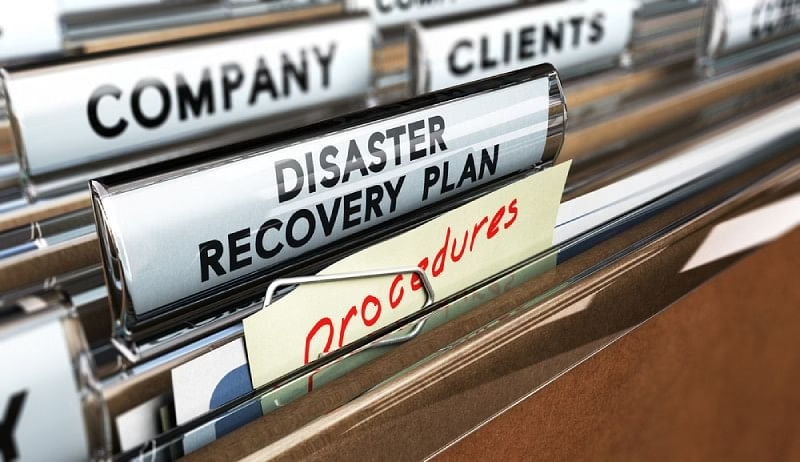
Patti ONeill and Gale Bergado’s Tips for Creating a Business Disaster Plan

The past year and a half has been stressful for everybody in San Francisco Bay Area. And I would argue it’s been doubly so for San Francisco Bay Area business owners. The thing is though, these things happen. Quite regularly. Maybe not global pandemics, but disasters in general. So, as the person in your corner who might be one of the only ones asking you these questions — What happens to your San Francisco Bay Area business if the building next door catches on fire? Are you prepared for the next hurricane, tornado, or hail storm? Every business needs to prepare for these eventualities. Do you have a plan? If not, let’s get you one… Patti ONeill and Gale Bergado’s Tips for Creating a Business Disaster Plan“Remember, today is the tomorrow you worried about yesterday.” -Dale Carnegie Every year, millions of new businesses are started across the country. Yes, millions. Unfortunately, a higher percentage of them will be out of business within five years. Most businesses close due to issues such as a bad business plan, poor execution, and other controllable factors. But in a typical year — 2020 being an aberration — approximately 10% of businesses close due to a specific external event. The unfortunate fact of the matter is that disasters can strike anywhere, any time. And this impacts businesses that aren’t prepared for it. So how can you prepare? Obviously, different business models call for different resources, but there are some generalities that apply to all businesses. Business Disaster Plan Tip #1: Cash Is King The first step is the most important: A business needs capital to operate, and while it’s easy to think you can simply bootstrap all the funding you’ll ever need if your ideal client can’t pay you, the money has to come from somewhere. Enter cash reserves. As a baseline, all businesses need at least three months of operating capital reserves available to them in cash or easily liquidated securities. These funds are earmarked only for emergencies and can be the difference between staying afloat while your business handles whatever disaster has befallen it.    At the same time, it’s important for you to understand two other important resources that can provide capital after a disaster. One is your insurance policy. Know what types of coverages you have, how to make a claim, and store copies of important policy documents away from the business location — such as scanned and uploaded to the cloud. The second is to know what resources will likely be available to you from local, state, and federal government agencies, including FEMA and the SBA. Contact our local emergency management agencies to learn more about what resources — including possible grants and emergency loans — are usually made available after local disasters. Learning about this stuff now will better equip you to navigate all the red tape later. Business Disaster Plan Tip #2: Know Your Customer The events of the past year will be studied for generations due to the impact the pandemic has had on businesses of all sizes. While many companies were forced to shutter their operations, other businesses were able to shift their operations into new markets and actually grow business while the economy shrank. In addition, many new businesses were started, as crazy as that sounds. The lesson here is simple: You must know your customer. This is critical for being able to survive a disaster situation. By knowing and understanding your customers, you’ll be prepared to do what is necessary to shift your operations to continue serving them. For example, a restaurant might be forced to close their dining room, but can they still handle take-out orders? Or, for example, could that restaurant cater meals for first responders, even if they couldn’t be open to the general public? OK, in light of recent events, maybe that’s the too-obvious example. So, how about a factory? Can production be shifted from one product line to another to meet the needs of the changing business climate? OK, maybe this is obvious, too, as some businesses were able to quickly shift production to make ventilators, masks, and hand sanitizer last year. Take the time now to learn more about your customers. Find out how they would respond in certain situations. Learn about what kind of support, products, and services they need and how their consumption changes during a disaster situation. Business Disaster Plan Tip #3: Secure Your Supply Chain It’s also important to understand how your suppliers will fare in a disaster. If you rely solely on one supplier for a key item, and that supply line is upset, your business could be forced to close. A far better plan is to foster relationships with multiple suppliers to ensure there are no challenges to you. Remember when the Suez Canal was closed this spring?  While this wasn’t a “disaster” in the traditional sense of the word, it created challenges for many companies that relied too heavily on only one means of bringing in supplies. At the same time, it’s also wise to know how your suppliers plan on dealing with disasters, too. What type of situations could affect them (which are different from what can affect you) due to location? Will they shut down a production line themselves – or shift production to other products? Where does that leave you, and what will you do about it? If you’re scratching your head on any of these questions, that’s OK. That’s the whole point of a planning exercise like this — to make you dig deep and find the answers now, rather than after disaster strikes. Business Disaster Plan Tip #4: Creating The Plan Common sense would dictate that no one can create a plan to handily cover all disasters – in the last year, we’ve seen monstrous wildfires, cities torn apart by riots, a global pandemic, and transportation and supply line disruptions. Every one of them impacts somebody’s business, and a hurricane offers a far different “type” of disaster than a localized riot. Any disaster plan simply starts with asking “What if?” and beginning to think about

Business Growth

Thoughts on How San Francisco Bay Area Business Owners Can Achieve Business Solvency

With our nation celebrating its 245th birthday on Sunday, and all of this talk about “independence” flying around, I have a question for you — one that I think you should think hard about: Are you achieving the independence you wanted in your business? As you know, it’s hard — and it’s LONELY — to be a San Francisco Bay Area business owner in this environment. Achieving business solvency can seem like a formidable task as you see the constant barrage of chaos and fear the media throws at your customers (and maybe even trickling into your own consciousness as well). Which is why it’s so important for you to have a clear handle on the bottom line for your business — and on ALL of the tax implications you’ll be facing under the new tax code, and how to get ahead of them. In short, how to achieve business solvency. For instance, are you taking every deduction possible for this year … and, if so, are you properly accounting for them? For example, one of the big last-minute tax strategies a lot of my clients like is the “heavy vehicle” write-off. When you purchase a heavy vehicle (defined as a vehicle with GVWR of over 6,000 lbs.) that is used 100% for business — well, then you can write off 100% of it. To do this, we use Section 179 in conjunction with bonus depreciation. And, if your vehicle is used 70% for business, then you can write off 70%. But this only works with a “heavy vehicle.” If you don’t have a heavy vehicle but use your vehicle for business purposes, you can still get a deduction, it just won’t be as much. You don’t even need to pay cash for it. You can finance it and still get that write-off. But here’s something that can cause a little problem: What happens when you sell the vehicle? Well, I’ll tell you: Before you sell, you have to calculate how much of a “gain” you’ll have. Estimated sales price:  xx,xxx Less: Cost of sales       ( x,xxx) Less: Basis                  (   000) Gain:                           xx,xxx Gain is taxable. In the past, it was possible to trade in your vehicle for a new vehicle. It was a “like-kind” exchange for vehicles. Effective 1/1/2018, like-kind exchanges only worked for “real property.” If you “trade in” a vehicle, the value given to the old vehicle is taxable. Another strategy is to distribute out the vehicle at fair market value. It’s distributed to a business owner. Of course, this only works if you have a pass-through entity. If the vehicle got hard use and/or a lot of miles, the vehicle’s fair market value will be lower. Look up the value using the Kelley Blue Book. The FMV could be taxable to the shareholder or could be treated as a payment against a shareholder loan. These are the kinds of analyses that we can make for you — and help you to plan for so that you can get on the path to business solvency. And look … I write about many things in these notes — from adding to your revenue line (sales, marketing, etc.) to all of the many other items that matter to you and other San Francisco Bay Area small business owners.  But one of the BEST ways to grow your bottom line is to avoid all of the unnecessary expenses and taxes, which so many San Mateo businesses end up paying, simply because they didn’t plan ahead of time. This is our passion here at ONeill & Bergado. When I meet with a business owner, I often wear many hats — CFO, Marketing Advisor, COO, etc. — truly whatever fits the need of my client most precisely. Because business owners can make rash decisions in times of perceived crisis (like during “tax season”) — they often have unforeseen complications down the road. All of which gets in the way of achieving business solvency. Let’s get ahead of the process for you, (408) 241-4100. Warmly, Patti ONeill and Gale Bergado(408) 241-4100ONeill & Bergado

Business Growth

Patti ONeill and Gale Bergado’s Insights on Financial Planning for Business Owners

Last week in the start of our series on financial planning for business owners, we got a little carried away by all of the talk of “independence.” So, we took the opportunity to ask you a simple question: Are you achieving the independence you want in your business? But there’s another side to this question that you should consider, and it’s this: Have you considered paying yourself more out of your business? In some cases, it actually might make more sense to pay yourself less — but bring home more at the same time. It all comes down to starting on the right foot when it comes to financial planning for business owners. If you’re not clear on how you could accomplish that, then reading this blog right now could be very important. We spoke last week about cost basis, but these considerations are just one aspect of financial planning for business owners like you who are growing the tax-profitability of your business. When we meet with a San Francisco Bay Area business owner, we often wear many hats — CFO, Marketing Advisor, COO, etc. — truly whatever fits the needs of our client most precisely. Because business owners can make rash decisions in times of perceived crisis (like during “tax season”) — and they often have unforeseen complications down the road… Which is why it iscriticalthat we take a look at how things are set up for you and your San Francisco Bay Area business for the rest of 2021. Here in the middle of summer (and BEFORE the fall rush) is the perfect time to take a clear-eyed look at things and plan for the best outcome for your business come January. With almost-certain-to-be-drastic changes on the horizon, there may be expiring opportunities for San Jose businesses to save on their bottom line as it relates to tax and other aspects of their financial picture. Frankly, we’d like to avoid all of the unnecessary expenses and taxes which so many San Jose businesses end up paying, simply because they didn’t plan ahead of time. Or it could be as simple as saving on expenses — all with the goal of paying yourself MORE, however you get there (which, as we mentioned, could be just what you need this year). Or these upcoming changes could mean that we want you to pay yourself less. But we won’t know until we talk. Warmly, Patti ONeill and Gale Bergado(408) 241-4100   408-775-7800ONeill & Bergado

Business Growth

Patti ONeill and Gale Bergado’s Business Negotiation Skills FTW

Alright San Francisco Bay Area business owners, we’re going to move aside from tax-related things today (though there will be PLENTY to talk about as Congressional plans unfold) … and circle back into the nitty-gritty of how business works and share with you some business negotiation skills we’ve learned over the years. We write about this stuff because we don’t see a business relationship as merely transactional; we’re here to serve and advise San Jose business owners in a variety of situations. Occasionally, we’re pulled on to work through business valuation discussions, business succession planning, M&A transactions, etc. These are inherently complicated situations, of course … and they’re also inherently adversarial. It sure would be nice if business deals like these could always be amicable, and like playing pattycake … but sometimes business negotiation skills require that you strap on the armor and battle a little. And not just when it comes to buying or selling a business — this adversarial dance comes into play a great deal in the course of a business day. In which case, we have thoughts for you today… Patti ONeill and Gale Bergado’s Business Negotiation Skills FTW“Discussion is an exchange of knowledge; an argument an exchange of ignorance.” – Robert Quillen No matter what industry you’re in, or how far you go in your career, the ability to effectively negotiate can make the difference between success and mediocrity. Whether it’s a multimillion-dollar contract, a job offer, or a luncheon, here are some trenches-tested business negotiation skills that will bring you or any other San Jose business owner closer to your ideal outcome: • Know what you want in advance. Don’t go to the table without a clear, realistic idea of what you want to achieve. It will help you negotiate with confidence. • Ask for what you want. Don’t be afraid to make the first offer. You’ll set the tone for the discussion, and studies (and our experience) suggest that the negotiator who goes first usually comes closer to getting what he or she wants. • Understand what your partner wants. A successful negotiation should satisfy both sides. Instead of trying to crush your competition, find out what he or she hopes to get, and try to work together toward a solution that works for you both. • Don’t concede unilaterally. Usually, one side or the other has to give something up. If you do that, be sure to get a comparable concession from the other person. Giving away something for nothing will be taken as a weakness to be exploited. • Don’t rush. Time can be your friend if you’re willing to wait for the right deal. If the other side senses a deadline, he or she may be motivated to hold out until the last minute or try to force you into accepting unreasonable terms. Be patient and let the time pressure work against your partner. • Be ready to walk away. This can take a certain amount of courage, but it’s necessary to avoid being backed into an agreement you don’t want. If possible, keep an ally in reserve–someone with the power to approve or reject the deal. This can give you an out if you need to turn down a deal or motivate the other side to provide you with a better offer. If you’re a San Jose business owner getting into negotiations and want a little more of our wisdom to help you brush up on your business negotiation skills, let’s chat about it:Patti (408) 241-4100  Gale 408-775-7800 To getting things done, Patti ONeill and Gale Bergado(408) 241-4100ONeill & Bergado

Business Growth, Business Valuation

Patti ONeill and Gale Bergado’s Insights on Reducing Business Expenses

No matter how far around the block customers are waiting, in business, only one line counts. The bottom one. That’s why reducing business expenses is critical. Getting a grip on the costs of doing business brings you benefits both short- and long-term. “Cost controls” generally mean saving money (who doesn’t like that?) and laying the foundation for greater efficiency and profitability in the future. But how do you start? Well, the good news is that here at ONeill & Bergado … we eat this stuff for breakfast. Patti ONeill and Gale Bergado’s Insights on Reducing Business Expenses “There are so many things hiding in plain sight that are routinely pointed out to us to no avail.”  – Megan O’Grady You have two kinds of basic costs in business: fixed and variable. A fixed cost could be the monthly payment for your long-term lease. An example of variable costs might be what you pay a supplier. So, some great ways to start reducing business expenses is by looking at the financial blueprint of your business. All budgets in order? Does every department know what they have to spend? More to the point, do you know what they have to spend? Next, make sure you have a good reason for reducing business expenses before you start to implement cost controls. Why areyoutrying to save cash? Looking to save in one area to spend (and improve, you hope) another part of your business? Set up a spreadsheet with one axis for your departments and another for expenses. Assuming no one figure leaps out at you, you’re off and running. Question the prime suspects Reducing business expenses is easier in some areas of your San Jose Area business than others — staffing, purchasing, and property, to name a few. (You’ve probably got your own list in mind.) Starting to reduce business expenses first means examining each of these areas. Staff. Two standbys might help your San Jose Area business here: outsourcing or turning to freelancers to reduce FTE staff, and using technology to do the job of people. Check standards of your industry, too, to avoid overpaying even in this tight labor market. Right out of the gate these seem like tough decisions. But one big step in starting to reduce business expenses is scrutinizing all aspects of your San Jose business, with the current bottom line and eventual profitability your highest priorities. It’s not fun. It is business ownership. Purchasing. Are your suppliers cutting you the best possible deal? Is there another supplier just as good, but cheaper? There’s strength in numbers when buying, too. Can you partner with other San Jose Area businesses and get yourself volume discounts? Property. This category is a moving target right now. As businesses continue to recover and resume more normal operations, one question on everyone’s mind is whether recent work-from-home practices can continue. You’ll have to answer this one for yourself and your business/industry, but can some of your employees continue to work from home to cut your office/workspace expenses? Don’t forget to factor in utility costs – sometimes there’s cash to be found in just turning off the lights. These are just a few examples of areas that could be overspending. One giant red flag: Is any area of your business running over its original budget? Who to bring in Reducing business expenses takes a team. Your managers and employees, for instance, are boots on the ground for your budgets. Ask them where to save money and time. You’re also more likely to get their buy-in if you’re open and honest about the process right from the start. Your customers know more about your products and services than anyone. Ask them what you offer that they never need or use (no need for you to keep paying for that). Suppliers and vendors probably work with your industry a lot; ask their opinion, too. Then there’s the consultant question. An objective third-person is great, but consultants aren’t cheap. And even the best of them often produce reports that go on a shelf and nobody reads. As always when hiring most professionals, go with references from others in your industry. Remember to negotiate their fee. Always remember that you’re not trying to control costs in a vacuum. You have to identify what else will be impacted in your San Jose business if you decide to reduce business expenses. Will a cutback create a problem elsewhere? As you can see, this job is more than setting up a spreadsheet. Reducing business expenses is a never-ending job, but this should get you started on the process. If you’re wanting somebody who can take an objective look at your books and set them up RIGHT — to control for the proper things — let’s chat about it: Patti  (408) 241-4100  Gale 408-775-7800 To your bottom line, Patti ONeill and Gale Bergado (408) 241-4100 ONeill & Bergado

Business Growth, Business Valuation

A Financial Systems Check-Up For Your San Francisco Bay Area  Business

Your San Francisco Bay Area business obviously makes and spends money. The pluses and minuses add up (you hope) to being able to stay in business, and a look at the books tells you if your San Francisco Bay Area business is doing okay or headed for trouble. What are your books telling YOU? In our experience, it’s often the company’s financial system (or lack thereof) that makes the answer easy to discover or downright difficult. Have you looked at your own business’s financial system lately? Would you know how to read between the lines to interpret what you see there? Because a financial system for a San Francisco Bay Area business should provide a clear answer to that question. Such a system helps you function and takes the form of different records that let you — and such others as investors, lenders or auditors — see how your business is doing. Let’s take a closer look at what folks like us will be looking for, shall we? A Financial Systems Check-Up For Your San Francisco Bay Area  Business“I value self-discipline, but creating systems that make it next to impossible to misbehave is more reliable than self-control.” – Tim Ferriss First, a definition of terms to get on the same page. What you bring in and what you spend travels under a few different names. Bookkeeping. Aka recordkeeping, bookkeeping is the foundation of any business financial system and lets you keep tabs on what’s flowing in either of the two directions that money takes in your business (in your door and out your door). Depending on the size and complexity of each business, we’ve seen literal books kept, even handwritten, in a ledger or loose sheets of paper. You can also create simple electronic ledgers using Excel or some other spreadsheet program, or using a function in of the simpler business accounting software packages. Invoicing.First step in generating income is invoicing. You must get paid. The invoicing segment of your system should accomplish three things (these aren’t complicated): 1) Ensure that you get paid in a timely way. 2) Be something that you don’t need to spend too long maintaining 3) Communicate clearly to you and your San Francisco Bay Area clients. (Is the amount the customer owes front and center on your bill?) While most businesses include due dates on their invoices, many do not state their consequences for late payment. And how do you know it’s being delivered? Get a dependable delivery system: beyond snail-mail, a lot of businesses use email with a read receipt. Income. Today there are a dizzying number of ways to get paid. Cash or checks remain okay for many businesses — though as always be sure to have safeguards to validate personal checks. You can use electronic transfers and payments direct to your bank, or you can use online payment services such as PayPal or Venmo. Your payment policies can be more complex. These are the details of your payment schedules and discounts. For instance, does your customer get a discount for paying early or incur an extra fee for paying late? Refund policies are also key: spell them out clearly and completely because often there’s eventually conflict in a refund or return. A word of caution here: managing cash flow is another part of a financial system, and one that can cause confusion. Cash flow isn’t just income and outlay, but a matter of your day-to-day liquidity. If your business needs something, do you have the cash to pay for it? Cash flow is distinct from profitability, which tends to be more long-term. Managing cash flow also means having a sense of timing, knowing if you can spend cash against income that isn’t actually in your account yet. Filing.Your financial system can’t exist without good records: the bills, receipts, invoices, and many many many other documents that pour into your business. You need to keep these on hand and in clear order for a set period. You can keep paper copies in a filing cabinet, or go digital and scan and store documents in the cloud or on such external media as thumb drives. Most companies these days pick the digital option for convenience, space savings, and, hackers aside, security. The taxman cometh. One more reason to keep good records is taxes. Good document management saves the stress of scrambling for records when it’s time to prepare your tax return for filing — not to mention backing up your argument in a dispute with a tax authority like the IRS. Often storing documents is the least painful of preparations in this segment of your financial system. The bigger challenge is usually paying the taxes. It’s key that your financial system can help you estimate and bankroll for federal, state, and local taxes. Once or twice a month you will need a good system to check the books and either set the money aside or send the amount due. Mess up in this part of your plan and you can face fines (or worse). Financial systems differ with each company. If your business needs help with this, let’s talk: Patti  (408) 241-4100 and Gale 408-775-7800 To making business easier, Patti ONeill and Gale Bergado(408) 241-4100ONeill & Bergado

Business Growth

A Small Business Growth Strategy for San Francisco Bay Area Business Owners

We really loved watching the Olympic games the past few weeks. There was so much to see, be inspired by, and even something to learn about growing a small business. Yep, you read that right. Hear me out… It’s so hard to appreciate the amount of training and work that goes into one ten-second race. We here in San Francisco Bay Area only get to see the ten seconds. But these athletes have been preparing for years for those ten seconds. They’ve learned what their body needs to get it ready for its peak performance. And here’s the tie-in: a high-performing business needs the same kind of understanding. Think about the questions you ask yourself about your San Mateo business every day: What’s coming up that will impact our cash flow? What’s our schedule to pay off debt? Are we on track to avoid tax trouble? How can we find time for those projects we’ve wanted to start? It all takes time, experience, and intentional planning to build. Your business has two pulses. One for your money and one for your future business goals. Getting a handle on both opens the door to short-term success and long-term profitability. The best way to answer these and other questions is to create a schedule (a training schedule, to continue the analogy) around the rhythm of your business… a very important small business growth strategy. A Small Business Growth Strategy for San Francisco Bay Area Business Owners“Rhythm is something you either have or don’t have, but when you have it, you have it all over.” – Elvis Presley Good businesses use strategic planning (probably an annual process) that involves activities happening by a set date. What are those dates in your San Francisco Bay Area business? How do you and your team work toward them? That’s your business rhythm. And establishing a rhythm is a key small business growth strategy. Basically, you’re trying to map the big events of your business — including deadlines, activities, and development opportunities — to make sure your entire staff is on the same page of the calendar. This helps your team collaborate and reduce redundant tasks and lets you see what your business must accomplish over the coming year and beyond. (You can pick any length of time you want, but a year is generally the easiest short-term period to examine). Let’s take your finances first. Your long-view aim is to grow profitability. It’s hard to do that, though, without a firm view of your current numbers — and the rhythm of when those numbers become available. Are you getting a look at final numbers as fast as possible? When do the books become final so you can see if everybody’s staying on budget? Do you get financial statements in time to act on them, or are they stale when they hit your desk? (Maybe it’s time to bring your finance team in for a chat.) Now, look through your past calendar to find milestones for your business over the previous year. You’re looking for events, initiatives, product or project launches … anything big that requires work beforehand. Notice when planning started for each and whether you think the team involved had enough time to get the job done. If they didn’t, you’re about to tinker with the rhythm of your business. Leverage the calendar The next stage of this small business growth strategy involves setting targets that build toward objectives, monitoring progress using financial benchmarks, and adjusting procedures as needed. (Again, your fiscal calendar may have a lot to do with this.) Let’s say you want to expand into a certain market segment but have been too slow and have lost ground to competitors making the same move. We might want to set target deadlines to begin networking or advertising in that segment, followed by monitoring to make sure you hit the deadlines as well as adding staff or resources if you missed them. How to accomplish this? If you’re going to continue developing this small business growth strategy, you first have to make sure the money’s there. Everyone should have a realistic budget (and agree to stick to it). Next, who needs to do what to make the deadline? You’ll need a timeline of the meetings and other activities and a schedule of tasks (with both short-term and final deadlines). If deliverables are involved in any of the target dates, work backward to set reasonable start dates for those deliverables. To use our earlier example, if the team designing an ad for that market segment has to get the ad to the San Francisco Bay Area media by a certain date before your sales team hits the field, make sure the designers are coordinating their work in time, and that the sales team is looped in. Everybody has to know what’s expected of them and when. And share this timeline. You can use anything from an intranet to a bulletin board. Whatever it is, put this timeline calendar in front of your staffers. The timeline for the above steps could cover the course of a year (as previously discussed). But simply changing the priorities and lengthening the time involved will allow you to set a similar rhythm for the long-term goals of your San Mateo business four or five years out. How’d it go? Get 360-degree feedback from your people and from (if any) your peers and supervisors to see what went right and wrong and how to refine the process. Fixing anything broken is important since you’re going to use this plan and rhythm to meet goals next year and in the long term. We’re happy to discuss this small business growth strategy and any other concerns about your business. Let’s set up a time to talk. (408) 241-4100 To making business easier, Patti ONeill and Gale Bergado(408) 241-4100ONeill & Bergado Feel free to forward this article to a business associate or client you know who could benefit from our assistance. While these particular articles usually relate to business strategy, as you know,

Business Growth, Business Tax Planning

Patti ONeill and Gale Bergado’s Latest Updates on Small Business Tax Deductions

One thing you can expect from us come rain or shine is to keep you in the loop on changes to all things tax-related. This week is no exception. There are some important changes to small business tax deductions rolling out, and not all deductions apply to all San Francisco Bay Area businesses. But first, let’s briefly talk 2021 Infrastructure bill. While the bill is getting some serious push and pull in the House, there are conflicting views on how this will affect small businesses. Per the Treasury, the bill will target tax increases on big corporations (raising the corporate income tax — i.e. C-corps —  to 28%, among other moves) while protecting the majority of small businesses (around 97%). But opposing sources argue that this doesn’t take into account the many small C corporations that could possibly be affected by the proposed corporate tax rate increase. In fact, according to the Tax Foundation “more than half of the pass-through business income could face tax increases.” There’s certainly more to come on this, and we’ll keep you posted as lawmakers reach a final decision. Now, even if we can’t stop a possible tax increase, we can help you with your small business tax deductions. Let’s jump into the most recent updates… Patti ONeill and Gale Bergado’s Latest Updates on Small Business Tax Deductions“Life is the art of drawing without an eraser.” – John W. Gardner Do your friends ever say that you’re lucky because you’ve got a business and can deduct everything on your taxes? Maybe you should get new friends… just kidding (sort of). But there’s no “maybe” when you’re watching how to take tax deductions for your San Francisco Bay Area small business. The rules keep changing.  What’s in a deduction? Though the tax reform of 2017 did away with a lot of deductions for individual taxpayers (at least for now), businesses still have a bit more leeway. Hundreds of deductions remain available to business owners (generally speaking), including complex ones of depreciation — which we won’t get into this time. Some small business tax deductions are infamous and fancy, like the “Hummer Loophole” where some business owners can successfully write off the entire purchase price of heavy SUVs. By no means are all deductions available to all San Jose businesses. So, let’s simplify the discussion here. Experts say small businesses are best off trying to use about six to ten strategies for taking tax deductions. First off (and most importantly), plan ahead. If you show up with the shoebox of receipts at the last minute and expect us (or any tax preparer, we warn you) to pull some magic deductions out of a hat… well, that’s not gonna work. Making deductions stick with the IRS takes time and work – especially when keeping records to back up your deductions. Some common small business tax deductions include office expenses (which we’ll discuss in a minute), cell phone expenses, and personal car mileage. These deductions are pro-rated between personal and business use – and again, we want to emphasize to San Francisco Bay Area business owners: document document document. Meal tickets Let’s look at those decades-old dependable biz deductions: meals and entertainment (M&E, aka wining and dining). For ages, it was assumed you could write off the whole cost of a steak dinner or even a ball game if you just took a business “associate” and mentioned business once or twice. Well, no more. Now, the rule is a “business associate” that ignites this whole deduction has to be someone you “reasonably” expect to do business with. The federal M&E deduction (claims for which still keep the tax courts mighty busy) recently became a little confusing. Rule-makers tried saying that meals were okay to deduct but not entertainment, leading many biz taxpayers to wonder how exactly you separate the two. Right now, business meals from a restaurant are 100% deductible through next year; the deductible percentage is expected to plunge again after that. The food you buy during an entertainment activity is also a separate deduction from the entertainment itself. Entertainment expenses are no longer deductible. Entertainment, according to the IRS, is “any activity which is of a type generally considered to constitute entertainment, amusement, or recreation,” listing as examples “entertaining at bars, theaters, country clubs, golf and athletic clubs, sporting events, and on hunting, fishing, vacation and similar trips.” Sometimes the wording of deduction rules is open to a little (or a lot of) interpretation. Did we mention tax courts? Home and away Let’s wrap up with two other common small business tax deductions. Home office: As more and more people are enjoying the beauty of working from home, this is one deduction that will require a little more pondering. A regular employee can’t take a deduction for the workspace. But you as a business owner or independent contractor might be able to deduct office expenses. If you’re self-employed, you have a few more options – but with the caveats that the space is your main place of business and that it is used exclusively for that purpose. Examples of allowable deductions: repairs and maintenance to the area used for business; utilities; real estate taxes; insurance; and home mortgage interest. The easy way to calculate your deduction is to basically take the square footage of your home office (up to 300 square feet) and multiply it by five dollars. The more complex method is finding out what percentage of your home’s square footage constitutes your home office and then pro-rate certain “direct” and “indirect” expenses. Make sure to check in with us (or the IRS) about these terms. Travel: The IRS considers a business day to be eight hours. For a 100% travel deduction for an entire day, at least half that time must be spent on a work-related activity. Note: Traveling from one destination to another is considered a work-related activity by the IRS. Spend four hours getting somewhere for a business meeting and you’ve qualified. Deducting your meals when you

Business Growth, Cybersecurity

Ransomware Defense Steps to Protect Your San Francisco Bay Area Business’s Computer Systems

No matter your line of work, your computer might be one of your most glaring vulnerabilities … and it’s one that too many San Francisco Bay Area business owners I’ve worked with don’t fully address. Even if you work with your hands, and you’re a sole practitioner (a contractor, a landscaper, a mechanic, etc.) … the little computer in your HANDS might hold the keys to your business. And whether you care to think about it or not, there are bad actors out there who want to break into it. One of the ways they are increasingly doing this is a nasty little thing called ransomware. So, as someone who cares deeply about YOUR business in its every dimension, I wanted to take a few minutes to give a rundown of known culprits and their recent attacks, as well as some ransomware defense steps, to help combat any possible breach of your San Mateo business’s data. (And yes, I’m keeping a sharp eye on the doings in Washington as it relates to this infrastructure bill … as of this writing, it has NOT yet been signed — but when it is, I’ll address what business owners need to know). Ransomware Defense Steps to Protect Your San Francisco Bay Area Business’s Computer Systems“You can never be too prepared.” -Regina King Let’s hear it straight from the FBI: Ransomware is malicious software (“malware”) that blocks you from accessing your computer files, systems, or networks and demands you pay a ransom for their return. You can download ransomware without even realizing it by opening an email attachment, clicking an ad, following a link or just visiting a website that’s embedded with malware. You usually discover the attack when you can no longer access your data or you see computer messages demanding ransom. Headline hacks A recent report showed that in 2021, a ransomware attack against businesses will occur every 11 seconds. Cybercrooks carry out more than 4,000 ransomware attacks every day worldwide. The big targets are companies in legal, manufacturing, automotive, technology, and healthcare industries. (The first documented ransomware attack, in 1989, targeted the healthcare industry.) Often the crooks don’t get the sky-high figures they demand, but on average organizations pay a ransom of nearly a quarter-million dollars. Ransoms are usually paid in virtual currency. Earlier this year, Colonial Pipeline coughed up millions to cybercriminals who’d hacked the oil giant’s network and sent East Coast fuel supplies into a tailspin. And only last week, the global consulting firm Accenture was attacked by the LockBit ransomware gang. A few cybercriminal gangs are behind many big attacks, such as the increasingly infamous REvil criminal gang of Russia (responsible for Colonial and for JBS Foods, which was attacked this summer and had to surrender an 8-digit ransom). Another nasty bunch is Egregor, which has connections to Ukraine and has cyber-extorted Barnes and Noble, Kmart, and others, sometimes publishing customer data on the dark web. Think you’re too small to get hit? About six weeks ago, a global chain reaction affecting thousands of businesses from pharmacies to grocery stores started with a back-door hacking of a common American software that all those businesses used. This shows that your business may be vulnerable in ways you don’t even realize. Ransomware defense steps you can takeIt could be only a matter of time before you and your San Mateo business have to deal with this crime. And a ransomware attack can really hurt your business, costing you both dollars and customer confidence even if you don’t pay a ransom. – Your best first ransomware defense is common sense. Download or open nothing you’re unsure of. – Keep your operating systems, software, and apps strong and updated, and make sure your anti-virus and anti-malware defenses are set to automatically update and scan your systems regularly. – Backing up data remains critical. Whether you use external media like thumb drives or back up in the cloud, double-check that those backups were completed. (Note: If you do back up using a cloud solution, you may be worried about the tech company being hacked. That’s a legit concern, but agreements with these companies often include responsibility clauses in case of a cyberattack. Check your contract. Also, cloud companies often have firewalls and other security far superior to what your company might be able to afford.) – Layout a plan for your company’s response to a cyberattack. Details here include who on your staff will be notified, as well as when and how; how to contact your insurance company and law enforcement; and prepared language to notify customers. (Most companies have used phrases citing their regret for the attack and that they moved quickly to address it.) – If you speak to your insurance carrier about coverage for a ransomware attack, expect a lot of questions about your cybersecurity – and talk of higher premiums. The insurance industry is still pretty new to this particular risk. It happened anyway – now what??You come into work one morning and find your data locked and some foul-looking screen telling you to fork over a ton in Bitcoin if you ever want to see your business info again. Don’t panic, for starters. Don’t believe this cyber-danger will simply go away. If we can offer any help on protecting yourself, please let us know. Besides providing some ransomware defense steps, here’s what we are EVEN better at helping you with: protecting your business from financial vulnerabilities. Whether that’s leaky books or a future tax-related disaster … we can spot problems coming from a mile away. If that’s something you want in your corner, let’s chat about it:(408) 241-4100  To your bottom line, Patti ONeill and Gale Bergado(408) 241-4100ONeill & Bergado

You have been successfully Subscribed! Ops! Something went wrong, please try again.

Contact Details

Our Most Requested Services

Quick Links

Importaint Link

Scroll to Top