Author name: ranjan.254

Business Growth

A Small Business Growth Strategy for San Francisco Bay Area Business Owners

We really loved watching the Olympic games the past few weeks. There was so much to see, be inspired by, and even something to learn about growing a small business. Yep, you read that right. Hear me out… It’s so hard to appreciate the amount of training and work that goes into one ten-second race. We here in San Francisco Bay Area only get to see the ten seconds. But these athletes have been preparing for years for those ten seconds. They’ve learned what their body needs to get it ready for its peak performance. And here’s the tie-in: a high-performing business needs the same kind of understanding. Think about the questions you ask yourself about your San Mateo business every day: What’s coming up that will impact our cash flow? What’s our schedule to pay off debt? Are we on track to avoid tax trouble? How can we find time for those projects we’ve wanted to start? It all takes time, experience, and intentional planning to build. Your business has two pulses. One for your money and one for your future business goals. Getting a handle on both opens the door to short-term success and long-term profitability. The best way to answer these and other questions is to create a schedule (a training schedule, to continue the analogy) around the rhythm of your business… a very important small business growth strategy. A Small Business Growth Strategy for San Francisco Bay Area Business Owners“Rhythm is something you either have or don’t have, but when you have it, you have it all over.” – Elvis Presley Good businesses use strategic planning (probably an annual process) that involves activities happening by a set date. What are those dates in your San Francisco Bay Area business? How do you and your team work toward them? That’s your business rhythm. And establishing a rhythm is a key small business growth strategy. Basically, you’re trying to map the big events of your business — including deadlines, activities, and development opportunities — to make sure your entire staff is on the same page of the calendar. This helps your team collaborate and reduce redundant tasks and lets you see what your business must accomplish over the coming year and beyond. (You can pick any length of time you want, but a year is generally the easiest short-term period to examine). Let’s take your finances first. Your long-view aim is to grow profitability. It’s hard to do that, though, without a firm view of your current numbers — and the rhythm of when those numbers become available. Are you getting a look at final numbers as fast as possible? When do the books become final so you can see if everybody’s staying on budget? Do you get financial statements in time to act on them, or are they stale when they hit your desk? (Maybe it’s time to bring your finance team in for a chat.) Now, look through your past calendar to find milestones for your business over the previous year. You’re looking for events, initiatives, product or project launches … anything big that requires work beforehand. Notice when planning started for each and whether you think the team involved had enough time to get the job done. If they didn’t, you’re about to tinker with the rhythm of your business. Leverage the calendar The next stage of this small business growth strategy involves setting targets that build toward objectives, monitoring progress using financial benchmarks, and adjusting procedures as needed. (Again, your fiscal calendar may have a lot to do with this.) Let’s say you want to expand into a certain market segment but have been too slow and have lost ground to competitors making the same move. We might want to set target deadlines to begin networking or advertising in that segment, followed by monitoring to make sure you hit the deadlines as well as adding staff or resources if you missed them. How to accomplish this? If you’re going to continue developing this small business growth strategy, you first have to make sure the money’s there. Everyone should have a realistic budget (and agree to stick to it). Next, who needs to do what to make the deadline? You’ll need a timeline of the meetings and other activities and a schedule of tasks (with both short-term and final deadlines). If deliverables are involved in any of the target dates, work backward to set reasonable start dates for those deliverables. To use our earlier example, if the team designing an ad for that market segment has to get the ad to the San Francisco Bay Area media by a certain date before your sales team hits the field, make sure the designers are coordinating their work in time, and that the sales team is looped in. Everybody has to know what’s expected of them and when. And share this timeline. You can use anything from an intranet to a bulletin board. Whatever it is, put this timeline calendar in front of your staffers. The timeline for the above steps could cover the course of a year (as previously discussed). But simply changing the priorities and lengthening the time involved will allow you to set a similar rhythm for the long-term goals of your San Mateo business four or five years out. How’d it go? Get 360-degree feedback from your people and from (if any) your peers and supervisors to see what went right and wrong and how to refine the process. Fixing anything broken is important since you’re going to use this plan and rhythm to meet goals next year and in the long term. We’re happy to discuss this small business growth strategy and any other concerns about your business. Let’s set up a time to talk. (408) 241-4100 To making business easier, Patti ONeill and Gale Bergado(408) 241-4100ONeill & Bergado Feel free to forward this article to a business associate or client you know who could benefit from our assistance. While these particular articles usually relate to business strategy, as you know,

Business Growth, Business Tax Planning

Patti ONeill and Gale Bergado’s Latest Updates on Small Business Tax Deductions

One thing you can expect from us come rain or shine is to keep you in the loop on changes to all things tax-related. This week is no exception. There are some important changes to small business tax deductions rolling out, and not all deductions apply to all San Francisco Bay Area businesses. But first, let’s briefly talk 2021 Infrastructure bill. While the bill is getting some serious push and pull in the House, there are conflicting views on how this will affect small businesses. Per the Treasury, the bill will target tax increases on big corporations (raising the corporate income tax — i.e. C-corps —  to 28%, among other moves) while protecting the majority of small businesses (around 97%). But opposing sources argue that this doesn’t take into account the many small C corporations that could possibly be affected by the proposed corporate tax rate increase. In fact, according to the Tax Foundation “more than half of the pass-through business income could face tax increases.” There’s certainly more to come on this, and we’ll keep you posted as lawmakers reach a final decision. Now, even if we can’t stop a possible tax increase, we can help you with your small business tax deductions. Let’s jump into the most recent updates… Patti ONeill and Gale Bergado’s Latest Updates on Small Business Tax Deductions“Life is the art of drawing without an eraser.” – John W. Gardner Do your friends ever say that you’re lucky because you’ve got a business and can deduct everything on your taxes? Maybe you should get new friends… just kidding (sort of). But there’s no “maybe” when you’re watching how to take tax deductions for your San Francisco Bay Area small business. The rules keep changing.  What’s in a deduction? Though the tax reform of 2017 did away with a lot of deductions for individual taxpayers (at least for now), businesses still have a bit more leeway. Hundreds of deductions remain available to business owners (generally speaking), including complex ones of depreciation — which we won’t get into this time. Some small business tax deductions are infamous and fancy, like the “Hummer Loophole” where some business owners can successfully write off the entire purchase price of heavy SUVs. By no means are all deductions available to all San Jose businesses. So, let’s simplify the discussion here. Experts say small businesses are best off trying to use about six to ten strategies for taking tax deductions. First off (and most importantly), plan ahead. If you show up with the shoebox of receipts at the last minute and expect us (or any tax preparer, we warn you) to pull some magic deductions out of a hat… well, that’s not gonna work. Making deductions stick with the IRS takes time and work – especially when keeping records to back up your deductions. Some common small business tax deductions include office expenses (which we’ll discuss in a minute), cell phone expenses, and personal car mileage. These deductions are pro-rated between personal and business use – and again, we want to emphasize to San Francisco Bay Area business owners: document document document. Meal tickets Let’s look at those decades-old dependable biz deductions: meals and entertainment (M&E, aka wining and dining). For ages, it was assumed you could write off the whole cost of a steak dinner or even a ball game if you just took a business “associate” and mentioned business once or twice. Well, no more. Now, the rule is a “business associate” that ignites this whole deduction has to be someone you “reasonably” expect to do business with. The federal M&E deduction (claims for which still keep the tax courts mighty busy) recently became a little confusing. Rule-makers tried saying that meals were okay to deduct but not entertainment, leading many biz taxpayers to wonder how exactly you separate the two. Right now, business meals from a restaurant are 100% deductible through next year; the deductible percentage is expected to plunge again after that. The food you buy during an entertainment activity is also a separate deduction from the entertainment itself. Entertainment expenses are no longer deductible. Entertainment, according to the IRS, is “any activity which is of a type generally considered to constitute entertainment, amusement, or recreation,” listing as examples “entertaining at bars, theaters, country clubs, golf and athletic clubs, sporting events, and on hunting, fishing, vacation and similar trips.” Sometimes the wording of deduction rules is open to a little (or a lot of) interpretation. Did we mention tax courts? Home and away Let’s wrap up with two other common small business tax deductions. Home office: As more and more people are enjoying the beauty of working from home, this is one deduction that will require a little more pondering. A regular employee can’t take a deduction for the workspace. But you as a business owner or independent contractor might be able to deduct office expenses. If you’re self-employed, you have a few more options – but with the caveats that the space is your main place of business and that it is used exclusively for that purpose. Examples of allowable deductions: repairs and maintenance to the area used for business; utilities; real estate taxes; insurance; and home mortgage interest. The easy way to calculate your deduction is to basically take the square footage of your home office (up to 300 square feet) and multiply it by five dollars. The more complex method is finding out what percentage of your home’s square footage constitutes your home office and then pro-rate certain “direct” and “indirect” expenses. Make sure to check in with us (or the IRS) about these terms. Travel: The IRS considers a business day to be eight hours. For a 100% travel deduction for an entire day, at least half that time must be spent on a work-related activity. Note: Traveling from one destination to another is considered a work-related activity by the IRS. Spend four hours getting somewhere for a business meeting and you’ve qualified. Deducting your meals when you

Business Growth, Cybersecurity

Ransomware Defense Steps to Protect Your San Francisco Bay Area Business’s Computer Systems

No matter your line of work, your computer might be one of your most glaring vulnerabilities … and it’s one that too many San Francisco Bay Area business owners I’ve worked with don’t fully address. Even if you work with your hands, and you’re a sole practitioner (a contractor, a landscaper, a mechanic, etc.) … the little computer in your HANDS might hold the keys to your business. And whether you care to think about it or not, there are bad actors out there who want to break into it. One of the ways they are increasingly doing this is a nasty little thing called ransomware. So, as someone who cares deeply about YOUR business in its every dimension, I wanted to take a few minutes to give a rundown of known culprits and their recent attacks, as well as some ransomware defense steps, to help combat any possible breach of your San Mateo business’s data. (And yes, I’m keeping a sharp eye on the doings in Washington as it relates to this infrastructure bill … as of this writing, it has NOT yet been signed — but when it is, I’ll address what business owners need to know). Ransomware Defense Steps to Protect Your San Francisco Bay Area Business’s Computer Systems“You can never be too prepared.” -Regina King Let’s hear it straight from the FBI: Ransomware is malicious software (“malware”) that blocks you from accessing your computer files, systems, or networks and demands you pay a ransom for their return. You can download ransomware without even realizing it by opening an email attachment, clicking an ad, following a link or just visiting a website that’s embedded with malware. You usually discover the attack when you can no longer access your data or you see computer messages demanding ransom. Headline hacks A recent report showed that in 2021, a ransomware attack against businesses will occur every 11 seconds. Cybercrooks carry out more than 4,000 ransomware attacks every day worldwide. The big targets are companies in legal, manufacturing, automotive, technology, and healthcare industries. (The first documented ransomware attack, in 1989, targeted the healthcare industry.) Often the crooks don’t get the sky-high figures they demand, but on average organizations pay a ransom of nearly a quarter-million dollars. Ransoms are usually paid in virtual currency. Earlier this year, Colonial Pipeline coughed up millions to cybercriminals who’d hacked the oil giant’s network and sent East Coast fuel supplies into a tailspin. And only last week, the global consulting firm Accenture was attacked by the LockBit ransomware gang. A few cybercriminal gangs are behind many big attacks, such as the increasingly infamous REvil criminal gang of Russia (responsible for Colonial and for JBS Foods, which was attacked this summer and had to surrender an 8-digit ransom). Another nasty bunch is Egregor, which has connections to Ukraine and has cyber-extorted Barnes and Noble, Kmart, and others, sometimes publishing customer data on the dark web. Think you’re too small to get hit? About six weeks ago, a global chain reaction affecting thousands of businesses from pharmacies to grocery stores started with a back-door hacking of a common American software that all those businesses used. This shows that your business may be vulnerable in ways you don’t even realize. Ransomware defense steps you can takeIt could be only a matter of time before you and your San Mateo business have to deal with this crime. And a ransomware attack can really hurt your business, costing you both dollars and customer confidence even if you don’t pay a ransom. – Your best first ransomware defense is common sense. Download or open nothing you’re unsure of. – Keep your operating systems, software, and apps strong and updated, and make sure your anti-virus and anti-malware defenses are set to automatically update and scan your systems regularly. – Backing up data remains critical. Whether you use external media like thumb drives or back up in the cloud, double-check that those backups were completed. (Note: If you do back up using a cloud solution, you may be worried about the tech company being hacked. That’s a legit concern, but agreements with these companies often include responsibility clauses in case of a cyberattack. Check your contract. Also, cloud companies often have firewalls and other security far superior to what your company might be able to afford.) – Layout a plan for your company’s response to a cyberattack. Details here include who on your staff will be notified, as well as when and how; how to contact your insurance company and law enforcement; and prepared language to notify customers. (Most companies have used phrases citing their regret for the attack and that they moved quickly to address it.) – If you speak to your insurance carrier about coverage for a ransomware attack, expect a lot of questions about your cybersecurity – and talk of higher premiums. The insurance industry is still pretty new to this particular risk. It happened anyway – now what??You come into work one morning and find your data locked and some foul-looking screen telling you to fork over a ton in Bitcoin if you ever want to see your business info again. Don’t panic, for starters. Don’t believe this cyber-danger will simply go away. If we can offer any help on protecting yourself, please let us know. Besides providing some ransomware defense steps, here’s what we are EVEN better at helping you with: protecting your business from financial vulnerabilities. Whether that’s leaky books or a future tax-related disaster … we can spot problems coming from a mile away. If that’s something you want in your corner, let’s chat about it:(408) 241-4100  To your bottom line, Patti ONeill and Gale Bergado(408) 241-4100ONeill & Bergado

Business Growth, Cybersecurity

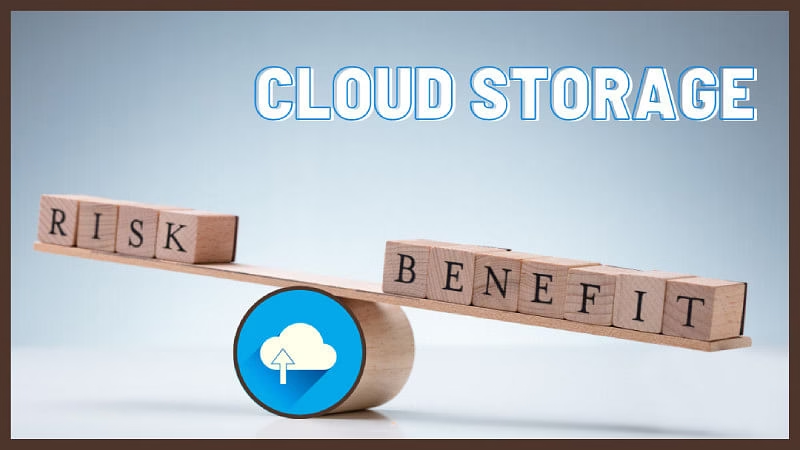
Cloud Computing Benefits and Risks for San Francisco Bay Area Businesses to Consider

In the olden days, San Francisco Bay Area business owners kept track of their records by hand in the old reliable notebook or ledger. So what an innovation it must have seemed to move business information to a floppy disk that could plug into a computer. The disks got smaller (and a lot less floppy – thankfully), but the idea fundamentally remained that be it floppy, hard drive, thumb drive, or even your own server, your customer and other business data were where you could locate it, most likely right on your premises. I personally know of many businesses that invested quite heavily into onsite server architecture and maintenance so they could keep up with the ever-increasing piles of DATA. Then, all of this was overshadowed by the cloud… Let’s take a look at cloud computing benefits and risks… Cloud Computing Benefits and Risks for San Francisco Bay Area Businesses to Consider“Saying that cultural objects have value is like saying that telephones have conversations.” -Brian Eno Basically, storing data in the cloud means uploading it via the internet to a third party’s electronic storage. You access the information there any time you want and somebody else has the worry of keeping your information accessible and safe. (“Cloud” supposedly comes from a cloud symbol to represent the internet on flow charts half a century ago.) Think of the cloud like a utility. You pay somebody to deliver electricity to your office even though you could try powering the place yourself with your own generator. As long as you keep the generator running, you’ve got power and are able to remain independent of using an outside provider. But suppose a fire or a flood destroys your generator? Out go the lights. Substitute “server” or “on-premises hard drive,” and that same flood or fire destroys your data. Who wouldn’t want to mitigate that risk? But as with all risk management, there are plusses and minuses – and that is also true of using the cloud. So, let’s talk about some cloud computing benefits and risks for San Francisco Bay Area business owners. The good points No hardware headaches. Storing data takes expensive hard drives and other hardware. All you need to store data in the cloud is an excellent internet connection (and of course a good computer – which you’d need even if you didn’t use the cloud). Providers by their nature must have the best equipment; costs of maintenance and repair also flows to them. Scalability becomes easy from your perspective, and, despite startup costs, long-term savings can also add up as you pay only for the cloud services you use. Just make sure upfront that it’s clear what services you’ll be able to use. Work on the run. Anytime access means you and your staff can work on business data anywhere from any device — which also means improved productivity. Support system. With the right cloud provider, you just hired a first-rate tech department. Most services have help available to you 24/7 – and because providing service to many clients is the providers’ bread-and-butter, their IT people are generally really good. Similarly, the cloud provider also must handle all the outage dangers and security updates (see below). They usually have a lot of backup servers in different locations to guard against downtimes and disasters. Risky business. If you’re leaning toward cloud storage, this can be the clincher: The provider has the burden of security. The one who’s really hurt most by a hack, the provider, will and can invest more than you in firewalls, encryption, backup servers, and other cutting-edge cybersecurity. Now for some cloud computing risks… Troublesome questions Bad connections. As I said,to access your cloud service, you’ll need an internet connection. Break that link for whatever reason, and you can’t get to your data – and this “downtime,” even for a short period, can cause a lot of pain. Control issues. Having someone else oversee and maintain the cloud infrastructure that houses your data can make you feel you’ve lost control. You populate the infrastructure but have little administrative control over how the data is stored. How easy is it going to be to migrate your data? Are you subject to vendor lock-in? Spotty support. That top-notch tech crew we talked about: Do you have access to them or are you expected to first try endless FAQs and online DIY fix-its? Security. Do you really want someone else guarding your data, even if their controls, firewalls, and other security measures are probably far superior to yours? Research does show that most data breaches and cyberattacks come down to customers’ mistakes and human error, so the provider can probably take good care of your data. But what if they can’t? Who’s liable? What are the damages and coverage? For that matter, what happens to your data if your provider is acquired by another company? Have these matters spelled out in your contract ahead of time. Sending your data to the cloud is appealing, but it also comes with some catches. And before you up the ante on storing your business data, you’ll want to think through some of these cloud computing advantages and risks. If you want some help with making the right decision for your San Francisco Bay Area business, let us know. Another thing we can help you with is protecting your business from financial vulnerabilities. Whether that’s leaky books or a future tax-related disaster … we can spot problems coming from a mile away. If that’s something you want in your corner, let’s chat about it: Patti (408) 241-4100  Gale 408-775-7800 To your bottom line, Patti ONeill and Gale Bergado(408) 241-4100ONeill & Bergado

Business Growth, Business Tax Planning

Disaster Recovery Planning Your San Francisco Bay Area Small Business Probably Needs

The phone rings in the middle of the night and a voice says your office is on fire. Early on a long weekend, that old pipe in the back finally bursts and no one will see the water for days. Or suddenly the Weather Channel’s saying a hurricane is barreling in your city’s direction. Oh, it’s always the other guy, you say? Ask the folks in Louisiana and Mississippi this week, or those out West most of this summer. Nobody in New York City ever used to even think about flash floods … According to FEMA, about *half* of small businesses never reopen after a disaster. Worse yet, one in four fails within a year, and nine out of ten shut their doors within two years. Not odds you want to bet against. So what do you do? If you’ve thought ahead, you pull out your disaster recovery plan for your San Francisco Bay Area small business. Disaster Recovery Planning Your San Francisco Bay Area Business Probably Needs“Success is the residue of planning.” – Benjamin Franklin When disaster hits, you have two jobs: 1) Stay open that day and 2) stay open in the days ahead. So, let’s take a look at the difference between a business continuity plan and a disaster recovery plan for your San Jose business, and why and when you need both… First off, both plans are actual documents (and they work best if you develop and use them together – in fact, a lot of people use the terms interchangeably). Unlike all those other reports you read once and then buried, these plans you pull out once a year to keep up to speed on preemptive approaches – in other words, you’re not waiting for those floodwaters to seep under your door before you know what to do. Your business continuity plan outlines how your business will keep going during a disruption. It includes procedures and instructions you and your team will follow when bad stuff drips (or gushes) down. Disaster recovery is how you’ll pick up your business again after a disaster… how you’ll get the doors unlocked… how you’ll start seeing customers again in the days ahead. Seems like common sense, right? But can you believe that a survey last year found more than 50% of companies don’t have a business continuity plan? Or that one in five execs of small and mid-size businesses don’t have a recovery plan? It’s difficult to imagine why anyone would risk the lost business, make themselves vulnerable to legal risk, a damaged reputation, or even possible fines and the loss of a business license. Just keep going To put it in simple terms, your business continuity plan looks like driving to the gas station while your engine warning light is still on — you’re trying to keep things going while the emergency is still happening. It doesn’t have to be a storm or wildfire on national news, either – you can even get hammered by something as small as a local power outage. The key is to assume that (for a little while) your equipment, workforce, office or workplace, third-party vendors, and just about everything else are unavailable. Here are a few questions you’ll want to answer on this front: – What jobs around your business can you NOT survive without, and who does those jobs? – How are you going to contact your people? Calling on the phone is everybody’s first thought, but don’t forget about texting and social media. You can keep staff updated on your Facebook page if you need to. – Who should your employees contact first? What shouldn’t they do? (Want ‘em talking to the local news?) – How will you keep phones and computers/servers working? Are there laptops somewhere else you can run on for a while? – Will you have to move your business, even temporarily? Where could you go? Your new normal Your disaster recovery plan tells you how to get your business back to normal as fast as possible. For instance, your recovery will probably hinge on technology. Part of your plan could be laying hands on your backup files that are in the cloud or on a portable hard drive that you keep somewhere far from your office. What’s your long-term plan to finance ruined computers? And of course, in this wonderful world, not all disasters involve water, fire, or wind. Suppose your business gets caught in a public relations mess… a bad lawsuit or a data hack. Part of your recovery plan should cover what statements you’ll make (deny all knowledge, we’re investigating, we can’t comment at this time, etc.) Both is better A lot of people combine the business continuity and disaster recovery plans. Suppose your inventory goes up in a warehouse fire. ‘Continuity’ means you call all your employees and vendors. Your recovery involves telling staff what to tell customers and notifying the right people at your insurance company. The point is, both types of plans work to keep you ahead of a problem. Do not wait to make them. If we can help let us know. You can even make that part of the disaster recovery plan for your small business. If that’s something you want in your corner, let’s chat about it:Patti (408) 241-4100 Gale 408-775-7800 To your bottom line, Patti ONeill and Gale Bergado(408) 241-4100ONeill & Bergado

Business Valuation

Things To Consider Before Selling Your San Francisco Bay Area Business

You’ve put in the years, labored long days, sweat the bad times, and high-fived in the good as your business grew. Now, it looks like it’s time to step away into the next life stage, slay the next dragon. It’s time to sell. (You think.) Whether you’re headed to another career or a seaside retreat, get what your business is worth before you walk away. Because if you’re not careful, you won’t. And, by the way, there are TAX implications that will absolutely come into play if you’re considering this. Your entity structure can make a big difference for what is possible. And we might want to consider together what entity formation you’re operating under, if you have this in mind. Let’s talk: Patti (408) 241-4100  Gale 408-775-7800 And one more thing before I dive in… Wednesday, September 15th is the due date for third-quarter estimated taxes. If you’re reading this, and it’s already past … don’t fret, just pay it now … there’ll be some small penalties, but nothing crippling. The idea is to avoid LARGER penalties if the clock continues to tick. Things To Consider Before Selling Your San Francisco Bay Area Business“Everything you’ve ever wanted is on the other side of fear. ”  -George Addai When you’ve been in the grind of running your business for a while, there inevitably comes a point where you begin to daydream about selling your business and moving on. The funny thing is, the actual sale can often show up right out of the blue. And since that’s true, you don’t want to be caught off guard by a lack of preparedness. Think, what would you want to see if you were the prospective buyer? (Solid numbers, for starters.) How do your assets compare with your liabilities? What’s your income stream? Make sure your annual financial statements are on hand and up to date showing your financial position, cash flow, and operations expenses. Have a professional (someone like yours truly) audit your financial statements going back about three years – which makes for a good-looking record, complete but not too long, especially concerning your profits. Don’t forget to include more recent financial info like Paycheck Protection Program (PPP) loans, if you had one. (Related to this topic and depending on your business, be prepared to talk with prospective buyers about any recent supply chain troubles.) This whole process lets you spot and highlight your best numbers for an eventual buyer. More importantly, you can find and fix any money or tax issues – because nothing can kill your deal faster. Get what you’re worth. It also puts you in a position to talk up how you beat your competition. By the way, you’ll want industry standards on hand to show how your San Jose business stacks up – and, more importantly, to make sure you get a good sales price. What if some of the numbers aren’t great? Then admit it. A buyer worth your time isn’t going to expect perfection in your operation, and it’s way better they hear about a problem from you now than unearth it in their due diligence. The buyer doesn’t want any surprises during this sale process. You want them even less. More landmines Your books are only the start when getting ready to put your business on the market. Here’s what else to do. Make nice with the taxman. Tax troubles are another surefire deal killer. If you have any doubts with any of the tax jurisdictions you deal with – your state or the dreaded IRS – make a call to see if you can check off that your tax history with them is squeaky clean. Be sure all of your filings and payment obligations are up to date. Keep your tax preparer in the loop – which leads us to the next possible trip-up. It’s time you got professional help. Selling your San Francisco Bay Area business is one of the biggest deals of your life. Do NOT risk tackling this without the help of a lawyer and/or tax expert.Remember: Odds are your buyer is going to know more ins and outs of this process than you do and probably with their own professionals advising them. Don’t go it alone. Ditto with marketing the business sale. Without experts to help, you might find yourself with fewer potential buyers – and you definitely don’t want that. Your employees aren’t leaving, remember? Do you have key people right now that thebusiness is going to want to keep? Talk early and often with a prospective owner about how to retain those folks. Sweeten the pot? This one gets overlooked a lot: If you’ve got a major account that depends on just you, groom an employee now to take it over. Your buyer is going to want to know that losing you doesn’t mean losing that account. Don’t forget — you do still have a job. Big, life-changing deals are exciting – and distracting. Don’t become so wound up in the sale that you forget the day-to-day management of your San Jose business. It’s not going to impress the potential buyer if you drop the ball on the current sale or your inventory comes up short because you forgot to place a big order. Force yourself to keep paying attention. Have a plan. Really, are you ready for this move? How exactly does the sale fit into your plan? Let’s say you aim to retire. Are you ready emotionally to leave the rat race? Got a plan to fill your suddenly free days? And whether you plan to kick back or immediately go into another business, is this sale going to net enough to meet those goals? This could be one of the biggest things you ever do, so take the time to think through and prepare for it — and find a professional you can trust to walk you through the process. We’re always here to help you… and your San Francisco Bay Area business. Patti (408) 241-4100  Gale408-775-7800 To your bottom line and a beautiful exit,

Business Growth, Business Tax Planning

Small Business Tax Credit Updates San Francisco Bay Area Owners Will Want to Consider

We wanted you to know about something that came across our desks the other day because it is potentially very good news… Not many are talking about this, but there have been some MAJOR new Economic Injury Disaster Loan (EIDL) program updates from the SBA… While I like to steer clear from “recommending” that anyone take out a loan, San Francisco Bay Area businesses seeking low-cost access to capital absolutely should be evaluating the EIDL option in light of the new and highly favorable changes. These are 3.75%, fixed-rate, no fees (if you apply directly through SBA), 30-year repayment term, and no personal guarantee if the amount is $200,000 or less … … those are pretty incredible terms. Thought you’d be interested. (Though the response time on actually receiving increased funds has widely run the gamut, from what we’re hearing. Don’t expect that this will be a “rapid” infusion of cash.) That’s just one of a few changes you should know about. The rest, we’ll cover below… Small Business Tax Credit Updates San Francisco Bay Area Owners Will Want to Consider“I always tried to turn every disaster into an opportunity. ”  – John D. Rockefeller Businesses and their owners the country over have been enjoying some great small business tax credits from the federal government in the last 18 months. But, as 2021 is winding down, it’s important to know that some of them are on their way out. Small business tax credits soon ending for San Francisco Bay Area employers this year: So, let’s start by talking about the Employee Retention Credit (ERC), which has been a tax boon to small and midsize San Mateo businesses trying to keep people on the payroll. Washington looked to keep the ERC available through the end of the year, but the powers that be on Capitol Hill may pull the plug early as part of that headline infrastructure bill. Nobody knows right now if the ERC or some version of it will stay alive. Stay tuned. Small business tax credit changes in the pipeline – maybeNow we come to what might happen. Lawmakers love to change things, and there are proposals right now to do just that to your taxes … and, of course, not always in a good way. You have to plan for a lot of outcomes, sometimes. For instance, if your company is what’s called “a pass-through entity,” there’s a new bill in Washington you should know about. The Small Business Tax Fairness Act will try to lower the amount of money you can make and still get the tax deduction for your “qualified business income.” On the plus side, the Act does also look to expand who can take the deduction to include accountants, financial advisors, attorneys, doctors, and other professionals. Please get in touch if you’re one of these companies and want to know more. Never a dull momentRecent events have inspired some to think, “I’ve had it. I’m selling my San Francisco Bay Area business and retiring sooner rather than later.” If you’re in this camp, as far as taxes go, you have two choices: Slam on the brakes or put the pedal to the metal. Crazy, right? But this schizophrenia can be explained because “tax the rich” proposals in Washington want to hike capital gains taxes and kill the step-up in basis (a type of valuation for tax purposes that historically has protected heirs from larger tax bills). So, you’re stuck. Sell your business down the road, and you could be socked with a big capital gains tax bill. Leave the business to your heirs instead, and the IRS may wallop them eventually because by that time they’ll no longer have the shield of step-up in basis. What to do about these small business tax credits from the federal government coming to an end? Well, the discussion about the above on Capitol Hill is still, right now, just proposals. That could change any day. Watch for more back and forth in Washington. And, for the rest of us in the real world, more suspense as we plan for taxes. If you sell online, watch outLet’s look at state taxes, too – especially if your San Jose business has joined the e-commerce boom, and you sell over the internet. You may have noticed that states (and other tax jurisdictions – watch out here for cities and even towns) are always claiming to be short of cash. With not as many people staying in hotels or eating in restaurants over the past several months, that’s a lot of sales tax states didn’t collect. So, what are they doing about it? Looking around for small businesses that sell more products online. This actually started a few years ago with a Supreme Court case called Wayfair. It basically gave the green light to states to start demanding that if you sold enough in their area, you have to collect and send back to states sales tax on the purchases no matter where your business is. Sounds simple – except every state and more than a few municipalities around the county have their own tax rates and deadlines for you to file and pay. And they’ve plenty of penalties to whip out if you mess up. Typically, you do have to sell about six figures annually in the state or have a set number of transactions – but these rules change all the time. In this and all tax matters, your business is too valuable to leave to chance. Talk to us if you need help with this ever-changing world. We’re always here to help you with this stuff … and ALL of your business. Patti (408) 241-4100  Gale 408-775-7800 To your bottom line… and to paying less tax, Patti ONeill and Gale Bergado(408) 241-4100ONeill & Bergado

Business Growth, Business Tax Planning

Is The Employee Retention Tax Credit Right For Your San Francisco Bay Area Business?

There is a LOT of smoke emanating from Congress right now. As usual, with Congress, there are always rumors and mutterings — what matters is what is actually signed into law. And we’ll keep you up to date on what you might need to know. But speaking of Congressional acts that have been signed into law … Wouldn’t it be great to get money for just having kept your San Francisco Bay Area employees afloat during the last rough-as-nails year or so? Well guess what? Maybe you can. Trouble is, Congress may soon take this deal away. Or it may not. Here’s the latest word on that and how you can still cash in – for now. Is The Employee Retention Tax Credit Right For Your San Francisco Bay Area Business?“Somewhere, something incredible is waiting to be known.” – Carl Sagan Late last year the Taxpayer Certainty and Disaster Tax Relief Act of 2020, following up on earlier relief laws, allowed the good folks at the IRS to give San Francisco Bay Area employers like you a real tax break. The Employee Retention Tax Credit (ERC) is a refundable tax credit – sort of a thank you from Uncle Sam – on the employer share of Social Security taxes that your business pays if you’ve been hit by the pandemic but kept your employees on payroll instead of laying them off.  Here’s how it works: If your San Francisco Bay Area business qualified, you could whack a chunk off what you paid in tax equal to, for this year, 70% of most wages you paid to employees through June 30. This applies to wages and compensation, in general, that are subject to Federal Insurance Contributions Act (FICA) taxes. How do you qualify? Two ways, primarily: You got dinged in the down economy or the government “closed you down” during a particular quarter because of the pandemic. Under the newest rules, if your business took at least a 20% hit for a quarter in 2021 compared to the same quarter in 2019, you are eligible. ERC regs for 2020 required a 50% decline over the same quarter in 2019 (or a government shutdown). A company can now have up to 500 full-time employees and qualify, up from 100 under old ERC regs. (Bigger companies can also qualify, but the wage restrictions are a little tighter.) The newer rules added ERC eligibility for the second half of this year for more businesses like public universities, hospitals and medical-care providers, “recovery startup businesses” that opened their doors after Feb. 15, 2020, and for all wages including for work and for paid time off. You can only get seven grand per employee per quarter max in 2021 but still, who couldn’t use this kind of cash? Where do you sign up? Not so fast – enter Congress Even as we speak, the House of Representatives is batting around the Bipartisan Infrastructure Investment and Jobs Act. It passed the Senate recently and the House is tweaking its own version. What’s that got to do with your tax break for keeping people on the job? A lot, as it turns out. Capitol Hill is thinking of killing the ERC for the last quarter of this year. Even if they don’t, they might tweak it so your San Francisco Bay Area business can’t qualify. Stay tuned – this could change or all be settled any hour. We’ll keep you up to date. Back to the future When the future’s uncertain, reach for the past: You can basically go back in time to apply for the Employee Retention Tax Credit . For instance, one of the beefs with the ERC in 2020 was that you couldn’t claim the credit if you’d received a Paycheck Protection Plan loan. Late last year, though,  the federal Consolidated Appropriations Act changed all that: Suddenly you could retroactively claim the ERC for payroll periods that were not paid with PPP loan money. No double-dipping, as it were. What’s it matter if Congress kills the ERC for the rest of this year? That’s when “retroactively” becomes a big word – you can amend past returns. To review: To qualify for the ERC, you had to have gross receipts fall significantly in a quarter of 2020 or 2021 compared with the same quarter in 2019, have operations unusually impacted by government order from the health emergency or you began business operations after mid-February 2020. Fit any of those? Then no matter what the House does in the coming days/hours/minutes, we can help you retroactively file using IRS Form 941-X (sounds like a spaceship but let us worry about that…) and possibly cash in with an ERC.   Yeah, you have to keep a lot straight to claim this tax credit – it would be no wonder if you’re confused. But if you think you fit those circumstances in any way, if you want to review your 2020 or 2021 quarterly payroll tax returns, or you know another business owner who could benefit, let’s chat. (408) 241-4100  To your bottom line… and to using the tax code to your advantage, Patti ONeill and Gale Bergado(408) 241-4100ONeill & Bergado

Business Tax Planning, IRS Audits

Using an IRS Accountable Plan to Maximize Deductions for Your San Francisco Bay Area Business

Any of you San Francisco Bay Area business owners remember those halcyon days when you could “talk a little business” with somebody while traveling … and then you got to write off the whole getaway on your taxes? Even if that ever really happened, that ain’t today. Now, the good folks at the IRS pull against their leashes to get at businesspeople who try to finagle an on-the-job tax deduction – and the taxman’s very best friend can be your own sloppy records. Get yourself an “IRS accountable plan.”  (Ahem.)Patti (408) 241-4100 Gale 408-775-7800 And before I dive into all that, one more reminder that this Friday, October 15th is the deadline for extended federal personal tax returns for 2020 (for the vast majority of the country). If you need a quick chat on this, use the info above and get in touch. In the meantime, let’s get your books “on lock” as the young people say. (Do they still say that?) Using an IRS Accountable Plan to Maximize Deductions for Your San Francisco Bay Area Business“It is time to restore the American precept that each individual is accountable for his actions.” – Ronald Reagan “IRS accountable plan” is a fancy way of saying “Reimbursing your employees — and yourself — without making the taxman mad.” You and your employees often reach into your own pockets for legit business expenses – sometimes for just a couple of bucks but sometimes for a lot more. Used to be if you had enough of these expenses, you could deduct them on your personal tax return. Then came the Tax Cuts and Jobs Act of 2017. Maybe you heard about it? Well, it pretty much erased the regular taxpayer’s itemized deductions for business. But what happens if you still need copy paper or to drive your car to see a client (or for that matter, call a client on your personal cell phone)? Do you just have to eat that cost? IRS accountable plans are formal guidelines that you create, which explain how you reimburse your employees for expenses and which ones qualify for reimbursement. (Reimbursements for expenses aren’t wages, so they’re not subject to tax.) Sound good? Can be – but it takes work. The deduction is in the details You won’t have to submit your accountable plan to the IRS but, if you want your deductions to hold up to scrutiny (yes, that scary word: “audit”), it’s a good idea to know what your accountant plan should include. (By the way, we’re going to talk more here about the plan itself than about the deductions themselves.) First, your “IRS accountable plan” doesn’t have to be written – but why shouldn’t it be? It makes everything clear to everybody in your company – and the IRS respects paper. Your plan should cover how much time your employees have to submit expenses; how they ask for reimbursement, including what documents are needed; what you’ll reimburse them for; the max that you’ll reimburse; and when employees should give back leftover reimbursement money. The IRS likes it if your plan also makes crystal clear how the expenses relate to your business. They also have to be substantiated in what’s called “a reasonable period” and your employee has to give back any expenses money they don’t spend in, again, “a reasonable period.” The IRS does seem to think that 30, 60 or 120 days is “reasonable” depending on whether it’s for your employee submitting expenses, you paying them, or your employees paying back excess. Some San Mateo biz owners might wonder, “What about small stuff like tips? I need records for that?” Well, the IRS is a little cagey on what they think “small” is. Some biz owners probably think records for anything more than ten bucks is a good idea. Others probably say five. Don’t guess. Keep everything, take no chances, and just document, baby, document. Go for the record Sure, they’re a pain to keep, but detailed records strengthen your case. There’s just no way around that. Keep them with your IRS accountable plan. Get yourself a designated logbook (hey, that’s an expense, too) and keep receipts, bills, and credit card statements. Photocopies will work. Detail detail detail those expenses: amount, time, place, and reason for the spending. “Twenty bucks for gas” doesn’t fly like “Twenty bucks for gas for this employee, on this day and time, at this gas station, because my employee was headed here to meet this person and here’s exactly how the whole relates to my business.” More pointers: Check with us if you have any questions … and keep every scrap of paper for records (and keep it organized if you can). You’ll be glad you did. If you need help formulating this …  well, that’s what we’re here for.Patti (408) 241-4100  Gale 408-775-7800 To more of your business’s money trickling into the bottom line, Patti ONeill and Gale Bergado(408) 241-4100ONeill & Bergado

Business Growth, Business Valuation

San Francisco Bay Area SMB Owners – Don’t Panic About The Business Supply Chains

Remember when the monster cargo ship Ever Given jammed the Suez Canal? After the Givenhad been stuck just five days, almost 400 other freighters were backed up waiting to pass through the Canal. Experts began predicting temporary shortages of everything from exercise bikes to coffee, cheese to semiconductors. For once, they were right — and not just because of one stuck ship. Recent events have proven how the world’s business supply chains can snap pretty easily (even now as I write, dozens of giant freighters wait off the coast of California because there’s no dock space). And have you been in Costco or Walmart lately looking for toilet paper or toys from China? Sometimes all that happens is a great chance for the store workers to dust the empty shelves and for you to pull out your phone and hope you can find online what you came into the store for. Well, your customers are no different if your business supply chain is weak. And soon they’re going to take their business elsewhere. Frustration is the one thing not in short supply these days. But don’t panic. I have thoughts. Before I get to them, one more reminder that October 15th is the deadline for extended federal personal tax returns for 2020 (for the vast majority of the country). If you need a quick chat on this, grab time here: (408) 241-4100 Now, let’s talk about those business supply chains… San Francisco Bay Area SMB Owners – Don’t Panic About The Business Supply Chains “Teach a parrot the terms ‘supply’ and ‘demand’ and you’ve got an economist.” – Thomas Carlyle First, as a frustrated San Francisco Bay Area business owner you’re not alone. There are many reasons that stuff is scarce for everybody now: If one thing gets hung up in transit in the business supply chain, then other stuff made from that first stuff gets hung up, too — often stuff your San Francisco Bay Areabusiness needs to function and to sell. Foam for furniture, electronics for cars, chemicals for paint. Prices spike for necessities like lumber for pallets. The dozens of other points in the chain are also vulnerable to labor shortages and other breakdowns. It’s like getting the kids off to school on a crazy morning: One hitch and the whole schedule can fall apart. … just like your relationship with your San Mateo customers when they’re staring at your empty shelves. Seat of your pants You may find yourself relying on gut feelings and improvising through your company’s supply crunch in the coming months. Money makes the world go ‘round — and it can make the supply chain go ‘round, too. Don’t spend like crazy, of course, but the hard truth right now is that you may have to pay a little extra to keep supply lines flowing. That means keeping your capital liquid and available as much as possible. Maybe a flexible line of credit can help keep your inventory stocked. Your other moves: It will get better (fingers crossed) Remember, when the business supply chain breaks, it’s not just your cupboard that’s bare — everybody loses money. And everybody’s struggling to fix the problem. Managing supply chains is no longer some minor business function stuck in the back office. The big boys have learned the hard way to make it an operational priority — probably for months to come — and give the job the resources it requires. Your business is in the same boat, so to speak, just on a smaller scale. You’ll get through this, and we’re here to help you do it. (408) 241-4100  Stay safe and sane out there, Patti ONeill and Gale Bergado (408) 241-4100 ONeill & Bergado

You have been successfully Subscribed! Ops! Something went wrong, please try again.

Contact Details

Our Most Requested Services

Quick Links

Importaint Link

Scroll to Top